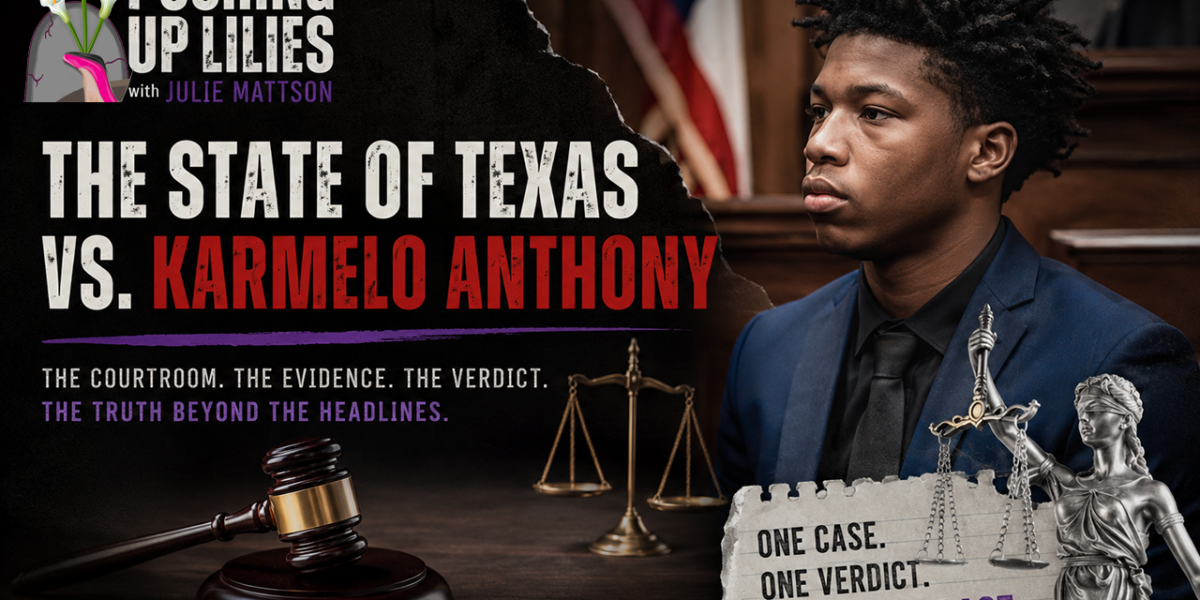
In last week’s episode, I explored the tragic death of 17-year-old Austin Metcalf and the events that unfolded during a high school track meet in Frisco, Texas. This week, I’m following the case into the courtroom as we examine The State of Texas vs. Karmelo Anthony.
During this episode, I’ll walk through the key moments of the trial, the arguments presented by both the prosecution and defense, and the jury’s ultimate decision. We’ll discuss the self-defense claim raised by the defense, the testimony presented during the proceedings, and the factors that may have influenced the outcome. I’ll also review the sentencing phase and the emotional victim impact statements delivered by Austin’s family.
As always, my goal is not to sensationalize tragedy, but to help listeners better understand the investigative and legal processes that follow a violent death. Cases like this often generate strong opinions and intense public discussion, but inside the courtroom, decisions must be based on evidence, testimony, and the law.
Join me as we take a closer look at one of the most closely watched criminal trials in recent Texas history and examine the legal journey from a fatal encounter to a murder conviction.
EPISODE TRANSCRIPT:
00:06
Welcome to Pushing Up Lilies. I’m your host, Julie Mattson. Pushing Up Lilies is a weekly true crime podcast with spine-tingling, unusual, and terrifyingly true stories from my perspective as a forensic death investigator and a sexual assault nurse examiner.
00:24
Do I have some stories for you? Are you ready? Hey guys, welcome to another episode of Pushing Up Lilies. Super excited. This is my 202nd episode. And I just want to thank everyone at the Louisville Police Department.
00:48
I spoke with their volunteers last night and I do it frequently, probably, I don’t know, once or twice a year. But it is so fun to go and visit with them. They love to hear about death investigations and exactly what death investigators do.
01:06
And it’s such an amazing group of people. And they donate so much of their time. Big shout out to that group for having me and making me feel welcome. I went into the new Louisville Police Department and it’s beautiful.
01:20
I’ve not been into the new building yet. I know that many of the officers were wondering how long it was going to take before they could get moved in, but it’s really pretty. Thank you again. I appreciate y’all so much.
01:33
This week, I need to touch on the Austin Metcalf case. I covered the Karmelo Anthony trial last week, and I just need to give y’all updates because this is in my area. It’s right down the street. So last week we talked about Karmelo Anthony, a student in Centennial High School here in Frisco.
01:55
He was charged with first degree murder back in April of 2025 for stabbing 17-year-old Austin Metcalf during a high school track meet. And one of the biggest controversies occurred before the testimony even began.
02:10
This was when the jury was chosen because the final jury actually consisted of 12 jurors and there were six alternates, but there were no black jurors seated despite Karmelo Anthony being black. Not a big deal, right, to me, just because color to me is not important.
02:33
But defense attorneys actually challenged the prosecution’s removal of several black prospective jurors, arguing that there was racial bias. Prosecutors actually stated that those jurors were struck because they were educators.
02:50
It had nothing to do with race. And the judge sided with the prosecution. And of course, outside of the courthouse, supporters of Anthony and Metcalf gathered, and tensions ran a little bit high. Wouldn’t want to be in the area during that time.
03:10
On day one, the opening statements took place. The lead prosecutor told jurors that they would see evidence showing that Anthony actually initiated the confrontation and used a concealed knife during what would have been a minor disagreement over seating under a team tent.
03:32
Now, prosecutors argued that the stabbing was intentional and that it was not at all justified. Now, as far as the defense position, defense attorney Mike Howard said that Anthony found himself surrounded and frightened.
03:51
And the defense told jurors that Anthony acted on a split second during a chaotic confrontation and that he believed he was in danger. Their theme from the very beginning was self-defense. The prosecution’s first witness was Mark Porter, and he’s a forensic video analyst.
04:13
Porter actually walked jurors through the surveillance footage from multiple cameras around the stadium. Prosecutors argued the footage showed Anthony entering the tent area, a confrontation occurring, and then Anthony leaving immediately afterwards.
04:33
Now, jurors also saw body camera footage and surveillance evidence at that time. On day two, eyewitnesses took the stand. There were several teenage witnesses and friends of Austin Metcalf’s who testified.
04:51
According to reports, those witnesses consistently described Karmelo Anthony as the aggressor. Their testimony centered really on the argument beneath the tent, Anthony’s refusal to move, and the rapid escalation that followed after that.
05:11
Multiple witnesses described Anthony producing a knife during the confrontation. This was one of the most emotional days of the testimony because many witnesses personally knew Austin Metcalfe. And so you can only imagine how difficult that would be, especially for kids in high school.
05:31
Jurors also heard details about Austin’s final moments after the stabbing, which was also, I’m sure, very difficult to hear. Now, day three, the prosecution continued calling witnesses. Jurors heard from investigators, law enforcement officers, coaches, and also others involved in the aftermath immediately after the stabbing.
05:57
Now, one significant piece of testimony involved Anthony’s statements after the stabbing and body camera footage showed Anthony telling officers he put his hands on me. Now, that statement really became important because the defense argued it supported self-defense, while prosecutors argued that it did not justify the use of deadly force.
06:22
So, the prosecution ultimately called 21 witnesses before resting its case. Now, on day four, after the state rested, the defense began presenting its case. The defense focused really heavily on Anthony’s fear during the confrontation, the physical size difference between Anthony and the Metcalf brothers, because as we know, Austin’s brother, twin brother, was also present when this happened.
06:55
The defense also focused on the rapidly developing nature of the encounter, that high school track meet culture and crowded tent area, and the defense called six witnesses. One major surprise was that Karmelo Anthony did not testify.
07:15
Many legal analysts believe that hurt the self-defense claim because jurors never heard directly from Anthony about his state of mind. Closing arguments, the prosecution argued this was not self-defense.
07:30
They told jurors that Anthony brought enough into a verbal dispute and escalated an argument into a homicide. And they emphasized witness testimony describing Anthony as the aggressor and argued Austin posed no deadly threat.
07:47
Now, the defense maintained that Anthony feared for his safety and reacted in a moment of panic and urged jurors to consider whether the state had eliminated all reasonable doubt regarding self-defense.
08:02
The jury deliberated, and this was today. The jury deliberated for approximately three hours, and they returned a unanimous verdict, guilty of murder. Anthony reportedly broke down crying when the verdict was read.
08:19
His mother also became very emotional. Austin’s family, including his twin brother, was present in court. I think I heard somewhere that his brother had not been present in the courtroom until today.
08:32
Now, following the guilty verdict, the same jury immediately heard punishment evidence. And Austin’s family delivered emotional victim impact statements describing the devastation caused by his death.
08:47
And Anthony’s mother testified on his behalf and asked the jurors for mercy. The defense also sought a finding of sudden passion, which would have significantly reduced Anthony’s punishment range. But jurors rejected that argument.
09:06
Now, the jury sentenced Karmelo Anthony today to 35 years in prison for murder. And because Anthony was a juvenile at the time of the offense, he was not eligible for the death penalty or for life without parole.
09:22
So next, several things are to be expected. The judge is going to formally enter the sentence and issue commitment orders. And Anthony’s attorneys, of course, are expected to appeal. Potential appellate issues are going to be the challenges with the jury selection, the self-defense instructions, evidentiary rulings, and some trial procedure issues, which is not uncommon in a case like this.
09:57
Anthony will be transferred into the Texas prison system and eventually assigned a permanent unit. Texas parole eligibility rules are complex, so that’s going to depend on offense classification and good time credit.
10:15
So, a parole board, not the sentencing judge, will ultimately determine when he becomes eligible for release consideration. After the four days of testimony, there were 27 witnesses, of course, like I said, including video surveillance, body camera footage, and listening to both sides argue self-defense versus murder.
10:39
And the jury pretty much answered that question with this guilty verdict, a 35-year sentence. Just a heartbreaking case altogether. You can only imagine. I mean, after years of going to track meets as a kid, they were always fun, you know, like we always made friends with the other teams.
11:01
And both of these schools were in the Frisco area. I think they kind of expected this trial to last a couple of weeks and go into mid-June. And there’s going to be ongoing tension. The public interest remains high in this case.
11:19
It’s been devastating. I mean, it’s been a year since this happened. And poor Austin Metcalf’s twin brother, you know, was present at the time and apparently performed CPR on him after the incident. And I read somewhere that the medical examiner also testified that the wounds were terrible.
11:42
So, you can only imagine. I think I even read somewhere that they showed autopsy photos to the jury during the trial so that they could see what kind of damage the knife did to his heart. But yeah, so kind of a devastating case, hard for both families, a lot of tension in the area and a lot of racial tension.
12:06
And we all know, you know, color doesn’t matter. If the tables were turned and Austin Metcalf would have stabbed Karmelo Anthony, I would have still felt like Austin Metcalf would have been found guilty and also sentenced to at least 35 years.
12:23
It doesn’t matter. And again, I’m not a believer that race or color has anything to do with it. It’s just, I hate to hear this. And it’s just so close to home. And that’s kind of one reason why this case was interesting to me.
12:41
And it’s going to be interesting to see what happens from here on out. This week, I also want to talk about another case. And this happened on the morning of December 4th, 2024. This case is about the brazen daylight assassination of United Healthcare CEO Brian Thompson in New York City.
13:10
Now, this wasn’t just a murder. It was a meticulously planned hit with layers of forensic evidence, a suspect whose background raises profound questions and a case that is still unfolding toward the trial.
13:26
We’re going to, a little bit of a walk through the scene, the medical evidence, and what forensic experts like myself see in these details. Settle in, we’re going to see how one man’s death becomes a flashpoint for so much more.
13:42
Now, Brian Thompson was 50 years old. Brian was a husband, a father, and the CEO of United Healthcare. And United Healthcare is one of the largest health insurers in the country. So, on the morning of December 4th, 2024, he was in New York for an investor conference at the Hilton Midtown.
14:07
And what should have been a routine business day turned fatal. This was at about 6.45 a.m. As Thompson approached the hotel entrance, a masked figure emerged. And surveillance video actually captured the shooter firing multiple rounds from a pistol equipped with a makeshift silencer.
14:31
Now, Thompson was hit in the back and chest, and he collapsed on the sidewalk. And witnesses described the gunman walking away calmly before he fled on an electric bicycle. Now, from a death investigator’s standpoint, the rapid response in this case mattered.
14:52
Thompson was transported to the hospital, but the damage was catastrophic, obviously. Let’s talk about what the autopsy would reveal in a case like this. So, the medical examiner’s findings would center on penetrating gunshot wounds.
15:10
A shot to the back likely damaged vital structures, while a chest wound would affect the heart and major vessels. So, in my experience, these thoracic injuries are going to lead to rapid exsanguination, which, you know, the heart essentially is going to drown in its own blood.
15:34
So, unsurvivable without immediate extraordinary intervention and sometimes even with. Now, Brian Thompson was pronounced dead despite the efforts to save him, and the nation kind of lost its breath watching this unfold.
15:52
Crime scenes like this are priority in forensic investigations, obviously. New York PD and federal agents defended rather quickly. Key items recovered included shell casings engraved with the words deny, defend, and depose.
16:14
A clear reference to insurance industry tactics that have drawn public fury. Now, the silencer was improvised from an oil filter. It was a homemade suppressor that reduced noise enough for the shooter to escape.
16:32
Now, ballistics would match the projectiles to a ghost gun, which is an untraceable firearm assembled from parts of other firearms. Now, in death investigation, some of the things we look at in shootings are trajectory, stippling, range of fire.
16:53
Here, the shots were fired at close range from behind. So, this is kind of suggesting an execution-style ambush. There was no struggle, no warning that it was about to happen. The electric box, discarded items, and hotel surveillance created a really good digital and physical trail that investigators were able to meticulously follow.
17:20
This evidence speaks volumes. So obviously, this was premeditated. The inscriptions turned it into a message, basically, on the shell casings. I can definitely see how these details would shift the case from random violence into something a lot more calculated.
17:40
If you look at those shell casings and see those words engraved on them and you know who Brian Thompson is, you just put two and two together, right? This was very calculated. Now, there was a massive manhunt that followed this shooting.
17:56
And days later on December 9th, 26-year-old Luigi Mangione’ was arrested at a McDonald’s in Pennsylvania. So, he had fake ID, he had a silencer, he had a ghost gun, he had cash and other items that linked him to the scene via fingerprints, DNA, and or ballistics.
18:23
Mangione’, interesting enough, was an Ivy League educated engineer from a prominent family, but he had a history of back issues and apparently, he had had grievances with the healthcare system. Now, prosecutors allege that he stopped the conference and used disguises and actually executed this entire plan with precision.
18:50
He watched this guy. Now, from my lens, the digital footprint and the clothing fibers and residue, those types of things would be crucial. How does somebody go from quiet professional to assassin? It’s kind of crazy when you think about it.
19:10
I mean, Luigi Mangione’s background is both fascinating and troubling. He was a University of Pennsylvania grad. He had a tech and an engineering mind. He was a fitness enthusiast. He had spinal problems, and had multiple times, voiced frustration with insurers, although he had no direct prior ties to Thompson.
19:37
But all of the symbolic elements are really hard to ignore in a case like this. Defense strategies are likely going to include challenging the chain of custody on evidence or arguing misidentification or exploring maybe some mental health issues.
19:57
And of course, that may come up as well. A lot of supporters online have elevated him to strange folk hero status, which really complicates the jury pools. And I never glorify violence. No matter the frustrations with the system, Brian Thompson was a human being, and he was not a symbol.
20:25
He didn’t simply stand for United Healthcare. There was so much more to him. I mean, let’s face it, we’ve all had problems with the healthcare system. I mean, it’s just part of life. It’s something that many people struggle with.
20:39
I was talking to someone the other day about dental insurance and just how it’s still so expensive to go to the dentist. And sometimes it’s so expensive to have insurance. I mean, when I retired from the medical examiner’s office, because I didn’t have 20 years with this county, my insurance was going to cost me $1,200 a month.
21:01
And that’s after giving 20 years of time to the government system as an employee, still $1,200 a month. And if I weren’t married and didn’t have other insurance options, that would have been my only choice.
21:18
There’s just no way that the average person can pay $1,200 a month for health insurance, but that’s not Brian Thompson’s fault. He’s not the one that ultimately makes the decisions over whether or not a procedure is covered.
21:35
This was ultimately geared towards him and the insurance system, for sure. As of now, Mangioni faces state murder charges in New York, as well as federal weapons violations, and there’s a lot of other charges against him.
21:53
But pretrial hearings have focused on suppressing evidence. Of course, they want to change the venue due to publicity and admissibility of digital data. A full trial is expected to dive deep into forensics.
22:11
There’s going to be ballistic experts in a case like this, a lot of digital analysts, and of course, the medical examiner’s perspective on trajectory and all those things that we’ve talked about before that help determine what direction the shooting occurred from.
22:31
And also, you know, there’s cameras and we’ve talked about this before. You can run, but you can’t hide from a camera and surveillance is everywhere. People have it on their ring doorbell. You’re constantly being videoed from somewhere.
22:50
What we can expect with this case are battles over where this ghost gun came from, the effectiveness of the silencer, and whether the evidence proves beyond reasonable doubt that Mangione actually was the one who pulled the trigger and that it was intentional.
23:10
If he’s convicted, that could mean life without parole. So, the case is going to highlight vulnerabilities in executive security and just the dangers of people in society just being outraged over things that individuals can’t change.
23:29
CEOs can’t change. Presidents of the company can’t change. From a forensic perspective, this case really reminds us how science, autopsies, trace evidence, surveillance, and all those different things, pierce through narratives.
23:47
It’s about truth, not just the headlines. Cases like this kind of force us to confront issues in the system, and we don’t want to excuse violence. It’s not okay. It doesn’t matter how mad you are. It doesn’t matter who you’re mad at.
24:04
This is not okay. It’s going to kind of be interesting how this trial all goes down. Really sad that he was just innocently going to this meeting and then ended up getting gunned down in front of the Hilton.
24:19
I’m not exactly sure when this case is going to go to trial. I need to look in to see if they’ve actually set a trial date yet, but both of these cases are just devastating. And violence has always been rampant.
24:35
You know, I was telling somebody the other day when I worked in Harris County, I got so much experience because it’s a violent city. But now, I mean, it’s violent everywhere. It’s kind of sad because you can’t go anywhere to get away from it.
24:52
When I was a kid, we lived in Carrollton, which is not too far down the road, but there was a lot of violence. It was in North Dallas, you know, and my parents were adamant about getting us away from the Dallas area, getting us away from violence and away from drugs.
25:08
You know, they moved us to a small town north, kind of between Dallas and Oklahoma. And it was great. I was not exposed to violence and drugs. I mean, I know they existed, but I was not exposed to them.
25:22
And I think that had a lot to do with who I hung out with. You know, I did not hang out with the quote unquote wrong crowd. I hung out with people who had their head on their shoulders and weren’t violent and weren’t drug users.
25:34
Of course, we all drank here and there and maybe smoked a couple of cigarettes, but that’s all, you know? And so, my parents felt like they were doing the right thing by moving us out of the Dallas metro area.
25:46
But now it’s just like, it’s everywhere, you know, drive-by shootings and murder suicides. And everyone is so angry and they direct it at one person and it’s hard to see. I mean, as an investigator going to scenes, it’s hard to see.
26:06
Anyway, we’re going to keep an eye on both of these cases. Y’all, they’ve already selected Orlando as the location for CrimeCon 2027. Let me tell you that hotel is already sold out for all of the period of time.
26:25
And I am grateful that this is a smaller hotel than Caesar’s Palace because let me tell you, number one, Vegas is not what it used to be. You know, it used to be, I would hear stories about, it was so cheap to get there, and the hotels were cheap, and you could get a buffet for nothing, and you can drink for free while you’re gambling.
26:44
And that is true. You can still drink for free while you’re gambling, but it’s expensive. I mean, like I said, I had a dirty martini. It was $29 during one of my meals. And my husband and I split a meal because we’re both on the weight loss shots.
27:01
And it was still ridiculous. I think one day he got us a burger. I may have said this last time, but one day he got us a burger. It was $38 for one hamburger and fries. It was crazy. So, Vegas is not as cheap as it used to be, but I am glad that this new hotel in Orlando is smaller because it was hard to get around.
27:21
I don’t know how people lugged all of their merchandise. It was super expensive for me to have mine shipped, stored, and then shipped back home. I’m going to say it cost upwards of $3,000 just to do that, which is a hard pill to swallow when you don’t make any money podcasting.
27:40
So anyway, I’m just, still so grateful for all the friends that I met and all the lessons that I learned. I’ve actually had some people reach out to me asking about being a guest on my podcast and also having me as a guest on theirs.
27:55
So that’s super exciting. Now, I’m also starting, and I know that many of you don’t live in this area, but I am also starting a YouTube channel for my med spa. And it’s under the filling station on YouTube.
28:09
It’s called Beyond the Needle. And we’ll be live on camera talking about different things that we do there at the MedSpa. So that’s called the Filling Station Denton, Texas. Our website is thefillingstationdenton.com if you want to check it out.
28:24
We do have a weight loss program, and we do ship weight loss meds to other states. I have a handful of listeners who are on semaglutide or tirzepatide and we ship to them. So, if you’re interested in that, you can do a virtual consultation from your home, no matter what state you’re in, and we can get you approved and actually ship that to you.
28:45
If that’s something you’re considering, we also have peptides and we are glad to do virtual consultations and talk to you about those options. I’m happy to say that my podcast is among the top three nominated for Best of Denton.
29:00
And so starting June 12th, there will be voting on bestofdenton.com where you can vote for my podcast as best of Denton. So, I would appreciate you doing that as well if you have time to get online. And my MedSpa is also up for several different awards.
29:17
I believe Best Boss, Best Customer Service, Best Locally Owned Business, I think Best MedSpa, Weight Loss Program, SPA, and Specialty Services. So, there’s a lot going on. And I always feel terrible. I hate to keep asking people to vote, but it helps us so much as a small business.
29:40
And it helps so much as a podcaster. When you have awards and you’re recognized, it really helps to grow your audience. So, if you have a chance, I would love for you to subscribe, leave a review, share this podcast with fellow true crime enthusiasts who value the science.
30:02
I look forward to talking to y’all next week. I hope you have an amazing rest of the week, and I will talk to you soon. Bye, y’all. Thank you so much for joining me today on Pushing Up Lilies. If you like this podcast and would like to share with others, please do me a quick favor and leave a review on Apple Podcast.
30:23
This helps to make the podcast more visible to the public. Thanks again for spending your time with me and be sure to visit me at pushinguplilies.com for merchandise in past episodes.