
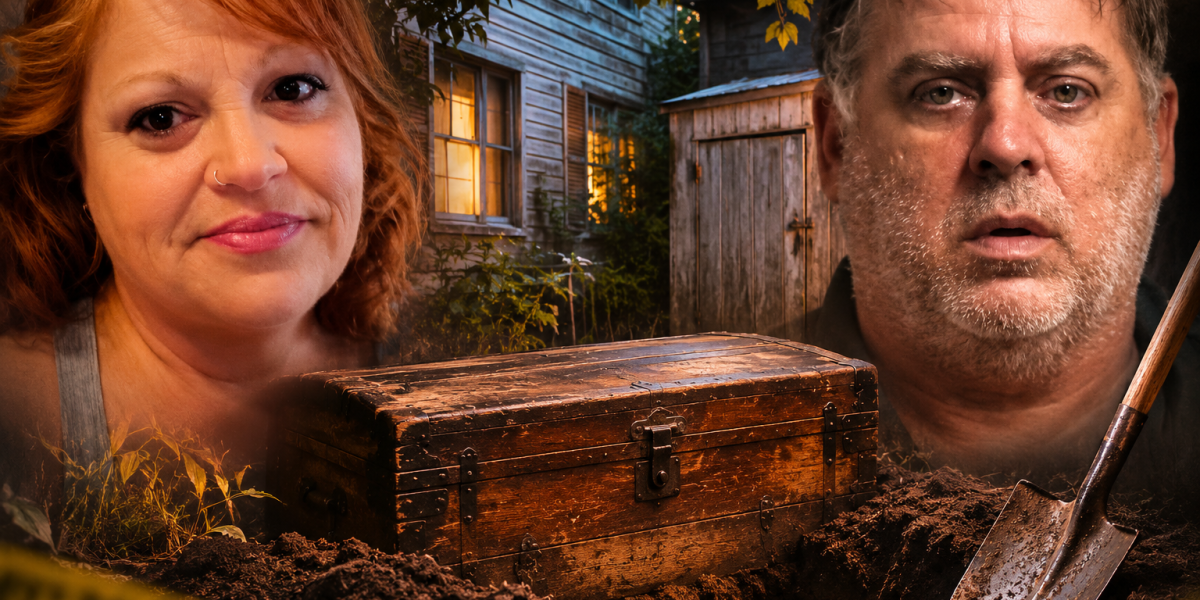
What happens when a woman disappears, her boyfriend claims she simply walked away, and the truth remains buried in her own backyard for more than two years?
This week on Pushing Up Lilies, I’m examining the heartbreaking murder of 51-year-old Penni Whiteside, who vanished from Myrtle Beach, South Carolina, in 2022. Investigators eventually discovered her remains inside a wooden hope chest built by her grandfather, buried beneath a backyard fire pit. Her former boyfriend, Sheridan Dirk Fogle, maintained that she had left him, but his story began to unravel as investigators uncovered disturbing evidence.
As a forensic nurse and former death investigator, I’ll discuss the challenges of examining decomposed remains, how investigators distinguish cause of death from manner of death, and the importance of witness testimony, crime scene evidence, and documented domestic violence. We’ll also look at the changing statements that led to Fogle’s murder conviction and the devastating years Penni’s family spent searching for answers.
Listener discretion advised.
EPISODE TRANSCRIPT:
00:06
Welcome to Pushing Up Lilies. I’m your host, Julie Mattson.
00:10
Pushing Up Lilies is a weekly true crime podcast with spine-tingling, unusual, and terrifyingly true stories from my perspective as a forensic death investigator and a sexual assault nurse examiner.
00:24
Do I have some stories for you? Are you ready? Hey, guys. Julie here with Pushing Up Lilies.
00:33
So happy to be back this week, and let me tell you, I am struggling through school, and I would love to hear from those of you who are in grad school or trying to get your master’s or your bachelor’s.
00:48
I definitely know how tough it is, and I’m feeling it this week. Staying up till twelve, one in the morning trying to get homework done.
00:57
I didn’t realize in clinical that you also have a lot of homework. So that’s been something that I’ve been trying to get done and stay caught up with clinical.
01:07
So, I’m doing clinical three days a week, and then I am at the med spa three days a week. So hopefully I don’t look as disheveled as I feel. But the week’s been great.
01:19
I’ve got like four weeks of clinical left. I see the light at the end of the tunnel. Then I have a month off, and then I’ll be going for, I guess, three more months from January to March.
01:31
And then at that point, God willing, I will pass my nurse practitioner exam and actually have my degree. So, after being a nurse for thirty years, it is hard to go back to school.
01:42
It is so hard to go back to school.
01:44
And I appreciate those people who have gone straight from ADN to BSN to MSN or even DNP because when you’re young and you can remember things, it’s so much easier. It’s just difficult when you’re…
02:01
I mean, I’m fifty-eight, so it’s just harder. It’s more difficult. And the good thing is my kids are grown. I don’t know how on earth I got my nursing degree as a single mom.
02:15
I mean, my kids ask me sometimes, and I’m like, “I really don’t know.” It’s kinda one of those things you have to do it, and you just push through. So, if that’s you, you got this.
02:24
And I’m here to celebrate all nurses who love to continue their education, and I think many of you know that I’m planning an education… I guess I don’t even know what to call it.
02:34
Planning an education series for nurses and for others who are interested in forensics and want to learn more about death investigation. Anyway, welcome back to Pushing Up Lilies. I’m Julie Matson.
02:48
Today, we’re gonna head to Myrtle Beach, South Carolina.
02:51
And this is a case that’s involving a missing woman and a boyfriend with a history of domestic violence and a discovery in the backyard of an apartment building more than two years after she disappeared.
03:04
So, this case recently went to trial, and the testimony actually revealed some disturbing details about what happened to fifty-one-year-old Penni Whiteside.
03:14
It just tells us how her body was concealed and how the man responsible continued living his life while her family searched for answers.
03:23
What makes this case particularly interesting to me, having worked as a forensic nurse death investigator, is the amount of information that investigators eventually obtained from the scene, the witnesses, and the suspect himself.
03:38
And there are some important forensic questions surrounding the condition of Penni’s remains and what a medical examiner is able to determine when a body has actually been buried for an extended period.
03:51
So, we’re gonna talk about all of that along with the domestic violence history, the investigation, and the testimony that ultimately led to a murder conviction.
04:00
Now, Penni Whiteside was fifty-one years old when she disappeared, and that was in the spring of twenty twenty-two.
04:07
She was originally from Virginia but made her home in Myrtle Beach, South Carolina, where she lived in an apartment on First Avenue South.
04:15
So, she had a son named Hunter and a brother, David Swisher, who would both become important figures in the effort to find out what happened to her.
04:24
Penni had been involved in a long-term relationship with a man named Sheridan Dirk Fogle.
04:30
And according to testimony presented during his murder trial, the two had been together since around twenty sixteen and had even been engaged at one point.
04:39
Their relationship was far from stable, though, and they reportedly separated several times over the years.
04:46
By the fall of twenty twenty-one, the relationship deteriorated, and there had been documented incidents of domestic violence, and that history would eventually become an important part of the prosecution’s case because it did establish the conflict between them that had existed long before she disappeared.
05:05
Now, the apartment where they had lived was part of an older house that was actually divided into five separate units.
05:13
So, Penni and Fogle occupied a unit towards the rear of the building close to the backyard and a shed, and that location also becomes significant later because the backyard was relatively secluded, and it was where investigators would eventually make their discovery.
05:29
Now, during the trial, one of the neighbors, Susan Barnes, said that Penni was quiet and that she kept to herself.
05:36
Barnes also explained that she was accustomed to seeing them together, and when Penni stopped appearing around the apartment building, her absence became very noticeable.
05:46
Now, I think it’s important to understand how these investigations develop in a missing person investigation.
05:53
Neighbors often become really familiar with routines without really consciously paying attention to them.
06:01
And I’m sure many of you are that way, where you have a neighbor that you kinda know their routine. You’re not really trying to be nosy.
06:10
You just know that they’re usually home at a certain time of day because maybe you’re outside and you see their car pull up, and you know more about your neighbors than you want to sometimes.
06:22
I know my neighbors probably feel that way about me. But you just become familiar with each other’s routines. Sometimes they know what cars belong to you.
06:31
They know, you know, when you leave for work and who regularly comes and goes.
06:36
And so, when somebody suddenly disappears from those routines, it sometimes takes a while before anyone realizes something is really seriously wrong.
06:46
So, in Penni’s case, her family also became concerned because she stopped communicating.
06:51
Her brother testified that they had maintained a relationship and spoke periodically, but family members had not heard from her for an extended period.
07:01
And by May of twenty twenty-two, the situation became concerning and the police got involved.
07:07
Now, on May tenth, Penni’s brother contacted the Myrtle Beach Police Department to report that she was missing.
07:14
And according to the original police report, he had said he’d last– and the family had been unable to establish contact with her.
07:23
But later, trial testimony indicated that family communication had actually continued into March.
07:29
But the important part is that by spring of twenty twenty-two, Penni was no longer responding to people that she normally did. Police officially opened their investigation on May eleventh.
07:40
Now, at that point, investigators were dealing with a missing adult. And those cases, as many of you know, present challenges because an adult has the right to leave a relationship.
07:53
An adult can move away and stop communicating with other people. And the fact that someone isn’t answering calls does not automatically establish that a crime’s occurred.
08:06
But investigators have to examine the circumstances surrounding the disappearance and determine whether the behavior is unusual and also identify anything suggesting that that person might be in danger.
08:18
But in this case, there were several circumstances that deserved attention.
08:24
So, Penni’s history of domestic violence with Fogle, her unexplained absence, and also the fact that he remained connected to the residence where she’d been living.
08:37
And when investigators spoke with Fogle in June of twenty twenty-two, he offered an explanation. He said that she left him and that he last saw her on April nineteenth.
08:48
Now, according to his account, Penni showed up with another man whom he initially believed was her brother and that they left together in a red Ford SUV.
08:58
And Fogle even gave a physical description of the man that he claimed had accompanied her.
09:04
But he also told investigators that he tried to contact her through multiple Facebook accounts and sent her messages because he was concerned about her whereabouts.
09:14
Now, there was another detail in this explanation that I found interesting.
09:18
Fogle referred investigators to an old social media post suggesting that Penni had once joked about faking her death and moving to Mexico to start a new life.
09:29
Now, a statement like that, it might sound unusual when presented during a missing person investigation, but you have to also consider the context.
09:39
So, people make jokes online, they post exaggerated statements, and they say things that have no connection to their actual intentions.
09:49
A social media post about disappearing doesn’t mean that someone voluntarily abandoned their life, especially when there are other concerning circumstances.
10:00
What I would wanna know is, is there any independent evidence supporting this story? Did anyone else see Penni leave in the vehicle? Was there any surveillance?
10:10
Did she access her bank accounts after? Was there activity on her phone that could be verified? Did she collect her belongings? Where was her purse?
10:19
Did she tell anybody else that she planned to relocate?
10:22
Those are the types of questions that actually help investigators distinguish between a genuine departure and an explanation created by someone who knows more than they’re admitting.
10:33
Now, at the time, police did not consider Fogle a homicide suspect. They actually interviewed him while the case was still being handled as a missing person investigation.
10:45
And recordings of those conversations would later become important evidence at trial.
10:51
In December of twenty twenty-two, investigators spoke with him again, and he continued to describe Penni as someone who had voluntarily left, and he showed officers a text message that he had sent her in May after the missing person report had been filed.
11:08
Now, the message gave the appearance that he was trying to contact a woman whose location was unknown.
11:14
He referred to police looking for her and expressed concern about her family being unable to reach her. Convenient.
11:22
Now, at first glance, those messages might seem consistent with somebody searching for a missing partner. But as investigators later learned, they were just part of a much larger deception.
11:33
So, what was happening during those early months was that Penni’s family was trying to find her while Fogle was providing an account of her disappearance that would eventually be exposed as false.
11:44
Meanwhile, the people living around the apartment buildings were beginning to notice that things didn’t make sense.
11:51
Again, we notice when our neighbors are behaving differently or when their habits change. We notice. Whether we want to notice or not, we unconsciously are aware, like I said before.
12:05
Now, Susan Barnes testified that she eventually asked Fogle where Penni had gone, and he told her that she went into another man’s car and that she left.
12:15
Barnes also described a conversation with another woman who had become romantically involved with Fogle after Penni disappeared, and the details of that conversation were not admitted into evidence because of hearsay rules, but Barnes was permitted to describe the woman’s demeanor.
12:32
Now, according to her testimony, the woman appeared fearful both for herself and for Penni. And after that encounter, Barnes actually became concerned enough to photograph the backyard.
12:43
She took pictures showing a pile of wood that had not always been there, and there was also a shovel near the shed that she took pictures of.
12:53
She also described seeing what appeared to be a piece of a blouse located near the shovel. We all know that’s a big deal. Those photographs were later admitted as evidence.
13:05
Now, other neighbors reported that Fogle had mentioned burying something in the backyard. They also described him becoming unusually territorial when people approached a fire pit in the area.
13:17
I wanna spend a little time on this because the behavior surrounding a concealed body sometimes becomes as important as the concealment itself.
13:26
When somebody hides a human remains on a property, that location becomes something they have to manage.
13:33
So, they might become concerned about construction or landscaping or animals digging or new tenants moving in or somebody rearranging the yard.
13:43
They might react strongly when somebody approaches an area that would otherwise have no particular significance.
13:50
Now, that doesn’t mean every person who protects a section of their property is hiding something.
13:56
But in the context of a missing woman and an unexplained change to the backyard, those observations become much more meaningful.
14:05
Now, in this investigation, the neighbors’ concerns eventually directed police to a specific area on the property.
14:13
And on June twelfth of twenty twenty-four, more than two years after Penni was reported missing, Myrtle Beach investigators executed a search warrant at the apartment building on First Avenue South.
14:27
Now, they focused on the backyard fire pit, and during the murder trial, crime scene investigator Lindsey Snail described the excavation. She testified that the soil was loose enough.
14:38
While walking over the area, her foot broke through the top of something buried beneath the ground, and that object turned out to be a wooden chest.
14:47
Now, investigators began carefully removing the soil and exposed this box. When they opened it, they discovered partially decomposed human remains.
14:57
Those remains were positioned inside the chest in an extremely confined space, and according to testimony, the body had been actually folded to fit inside with the legs bent towards the back and an arm positioned beneath the body.
15:11
So, investigators observed a distinctive tattoo that matched one that belonged to Penni, which helped them make a preliminary identification at the scene.
15:21
Now all of a sudden, this missing person investigation is a homicide investigation, and there’s something particularly disturbing about the chest itself.
15:31
Prosecutors explained that it was Penni’s own hope chest built for her by her grandfather.
15:38
Now, I don’t know if that’s even a thing anymore, but when I was younger, you know, I decided that when I grew up and got married or moved out on my own, that I was gonna have my kitchen…
15:49
My kitchen was gonna be decorated in ducks, which is very eighties, and it, it was the eighties, okay? But, you know, you start saving things.
15:59
You start collecting things that you know you’re gonna need when someday you get married or someday you move out.
16:05
So, her grandfather actually built this hope chest for her, and it was supposed to hold items that she wanted to grow up with and grow old with and have in her home.
16:18
And so according to the testimony, she had kept it through several different moves, including when she lived in Virginia and then later wrote– relocated to South Carolina.
16:30
So, it was a very personal possession. It had a family connection, and the prosecution alleged that Fogle used it to conceal her body before burying it in the backyard.
16:40
Now, from my perspective as a death investigator, a discovery like this requires a very deliberate approach to scene processing. So, you have human remains. They’re inside a container.
16:52
The container is buried, and the burial site has actually been exposed to the environment for an extended period.
17:01
Investigators have to document the location, the depth, the orientation, condition of the soil, construction of the container, and the position of the remains before anything’s disturbed unnecessarily.
17:16
Now, the way a body’s positioned inside a container actually matters because it helps establish what happened after death.
17:23
Investigators would want to distinguish between the body’s original placement and any changes caused by decomposition or gravity or movement during recovery.
17:36
So, the clothing, surrounding materials, soil, and anything actually found inside might also have evidentiary value. Even small details sometimes kinda help reconstruct that concealment process.
17:50
But one important consideration is that recovering a buried body is different from responding to a recent death inside a residence.
17:59
And, you know, we found buried bodies, I mean, pretty regularly, and you had to really be careful when you were looking around for pieces. It’s very different responding to a scene like this.
18:15
The body may have undergone extensive decomposition, and the surrounding environment actually becomes a big part of the evidence Soil conditions, moisture, temperature, and the construction of the container actually influence the rate of decomposition.
18:31
So, all those things are important. And a wooden chest isn’t really a sealed forensic environment.
18:37
There’s moisture and microorganisms and environmental conditions that still are gonna affect the remains, and investigators have to account for that when they’re interpreting the scene.
18:49
I would definitely photograph every stage of recovery, including the fire pit before excavation, the soil layers, the chest, and the remains the way they were originally positioned.
19:02
Once the chest is removed and the remains are transported for examination, those original relationships, they can’t be recreated. And I think we talked about this last week.
19:12
Like, once something’s moved, you can’t really recreate that.
19:16
So, if you have photos of it before anything’s moved, or you at least have reported information from EMS or whoever removed it so that you can put the picture together.
19:27
But that’s why detailed scene documentation is so very important. Another issue is identification.
19:36
In this case, a tattoo actually helped investigators recognize the remains, but a tattoo alone should not be confused with the entire identification process.
19:47
Depending on the circumstances, forensic identification may involve dental records, fingerprints, DNA, medical records, or other identifying information. And many times, that is what you have to do.
20:02
You know, it always got me ’cause people would be like, “Well, why don’t you get dental records?” Well, you have to have an idea who the person is. And I mean, in this case, they did.
20:11
I mean, they had a great idea, but you don’t always.
20:13
When you find a body randomly, I mean, not me, but when someone finds a body randomly, many times you don’t have a clue who the person is, so you don’t even know what dentist to go to.
20:25
I mean, they might not even live in that area that you are working in. So, you have to have an idea who the person is before you can just get dental records.
20:36
Now, if someone has never had a driver’s license or been arrested, their fingerprints may not be available. And so, think about that with children.
20:47
Obviously, if they’re under sixteen or fifteen, they have not been fingerprinted at the DMV, so they’re not gonna have actual prints on file.
20:58
So that becomes a problem because we really need to be able to identify people. And I know when I worked in Houston, there were times when we would take photos and remove the trauma.
21:12
At the time, I don’t think it was AI, I think it was all done manually, but they would remove the trauma and show the photos to the family, and then the family would identify them based on the photo.
21:23
They wouldn’t look at the body, they wouldn’t see the actual trauma, so they wouldn’t know exactly what the injuries are.
21:30
But we did that just to protect them because as much as sometimes the family thinks they wanna see the injuries, they really don’t. They really don’t.
21:39
So anyway, the tattoo is important, but it did not provide complete account of every identification procedure that’s performed afterwards.
21:50
So once Penni’s remains were recovered, the investigation shifted towards determining how she died and who was responsible.
21:59
Now, her body was examined by forensic pathologist Susan Presnell of the Medical University of South Carolina in Charleston. And at trial, Dr.
22:09
Presnell said that she classified Penni’s manner of death as a homicide. The suspicious circumstances surrounding the concealment of the body were an important part of her determination.
22:21
That brings up distinction that I think is worth explaining ’cause people a lot of times use terms of cause of death and manner of death interchangeably, even though they’re two totally different things.
22:31
Cause of death is the injury, disease, or physiological event that’s responsible for the death, and the manner describes the circumstances under which the death occurred, and it’s generally classified as natural, accident, suicide, homicide, or undetermined.
22:49
A homicide means the death resulted from the actions of another person.
22:54
It’s a medical and investigative determination separate from the legal question of whether a particular defendant committed murder.
23:02
Now, in a recent strangulation death, a forensic pathologist might look for hemorrhages in the neck, injuries to the laryngeal structures, fractures of the hyoid bone or thyroid cartilage, petechial hemorrhages, which is the little red dots, you know, in your eyes or that you get on your skin sometimes, other findings consistent with neck compression.
23:24
But there’s no single injury that must be present in every strangulation death, and so the absence of a particular finding doesn’t automatically exclude strangulation.
23:36
When a body’s been buried for more than two years, the examination becomes considerably more complicated.
23:42
Decomposition can destroy or alter all those soft tissues where many of those findings would normally be visible.
23:49
So, the structures needed to evaluate neck compression may not be intact, and it might be impossible to determine the exact mechanism of death through autopsy alone.
24:01
In Penni’s case, the public reporting did not establish a specific anatomical injury proving strangulation.
24:09
The medical examiner’s homicide determination was actually presented alongside the circumstances of concealment and other investigative evidence.
24:19
Now, the claim that Penni was strangled came from Fogle’s own account of the confrontation and from the prosecution’s interpretation of the evidence I think it’s important to keep those two things separate because forensic medicine has limitations, and an investigator should never claim that an autopsy established something unless the actual findings support it.
24:41
Now, there are cases where the physical exam provides an obvious cause of death, and there are cases where investigators have to rely on a combination of scene findings, witness statements, circumstances, and admissions.
24:57
And the fact that remains are extensively decomposed does not mean that the investigation stops.
25:02
It just means that that evidence has to be evaluated more carefully with an understanding of what the forensic examination does and does not establish.
25:12
Now, after Penni’s remains were found, investigators focused on locating Fogle, who surprisingly had moved away from Myrtle Beach.
25:22
But by that time, he was living in Orangeburg, South Carolina, and had a whole new life. He’d also married another woman.
25:30
So, on August twenty-ninth, twenty twenty-four, police arrested him in connection with Penni’s death.
25:36
And during his initial interview after being taken into custody, investigators told him that the missing person they had been searching for had been recovered.
25:46
Now, Fogle initially continued acting as though he didn’t know what happened, and he asked whether Penni was okay and maintained that he didn’t know her whereabouts.
25:56
Investigators then informed him that he was being charged with murder. Now, it was during a subsequent interview at the Myrtle Beach jail that his account changed dramatically. Go figure.
26:08
We know that happens. But for the first time, Fogle admitted that Penni died during a confrontation between them.
26:15
And he told investigators that she had actually approached him with a knife, and he was trying to leave the house at the time.
26:22
And according to his account, he attempted to push her, grabbed her by the throat, and they fell backwards onto the floor. And then guess what?
26:30
His memory became unclear during the struggle, and he blacked out. Go figure. Now, when he became aware of what had happened, he said Penni was on the floor and was no longer breathing.
26:41
So, he said he panicked, and that was the explanation he would eventually present as self-defense.
26:50
Now, when I hear someone describe a fatal neck compression incident and then claim that they can’t remember what happened during the most critical part of the struggle, I have a lot of questions, and I want to know whether there is independent evidence of the alleged weapon, whether either person had documented injuries, whether the physical findings are consistent with this account, and whether the explanation had changed over time.
27:17
A person’s claim of memory loss is not something that investigators should automatically accept or reject without evaluating surrounding evidence.
27:26
So, in this case, the difficulty was that the remains were not discovered until more than two years later, and Fogle had already concealed the body.
27:37
Now, that delay limited the opportunities to document the immediate scene, identifying a weapon or examine any fresh injuries.
27:46
Fogle told investigators that after Penni died, he left the room and used drugs, and he acknowledged using methamphetamines during the period when he was concealing her body.
27:57
Now, he then placed her remains in the wooden chest, reportedly keeping the chest inside the apartment for two days before he moved it outside.
28:05
And according to his statements, he spent several days digging the hole where he eventually buried the chest.
28:11
Now, he also described placing the fire pit over the burial location several weeks later, although he claimed it was not intended to conceal the body.
28:21
That raises an obvious question regardless of what he claimed his intention was.
28:26
The fire pit covered the location where Penni had been buried, and neighbors later described him behaving protectively around that area.
28:35
Fogle also admitted that other people had been inside the apartment while Penni’s body was still there.
28:41
Now, during one police interview, he described a man spending the night at the residence and discussing the possibility of becoming roommates while Penni’s body remained concealed inside the apartment.
28:52
I find that really troubling because he was continuing ordinary social interactions while dealing with the aftermath of her death, and he was able to communicate with other people, make arrangements, and continue presenting himself as someone whose girlfriend had left him.
29:08
So, the defense argued that he was traumatized and afraid, and that Fogle claimed that he didn’t know what to do.
29:16
But from an investigative standpoint, the actions that followed her death were important because they required decisions over an extended period.
29:24
Moving a body, placing it inside a chest, digging a grave, covering the burial site, and continuing to provide false information are separate acts, so they don’t occur in one instant.
29:37
And that sequence is important when evaluating a claim that everything resulted from an immediate panic response.
29:44
One of the most revealing parts of his recorded interview concerned the message he sent Penni after her death.
29:50
Investigators asked why he had continued sending messages to her phone, pretending to be concerned about her disappearance, and he acknowledged that the messages were intended to support his cover story.
30:02
Now, that admission was significant because it directly contradicted the explanation, he’d given investigators during the original missing person investigation.
30:12
He knew Penni was dead, yet he presented himself as someone trying to find her.
30:18
In death investigations, post-event behavior can be extremely informative, although it should never be treated as a substitute for evidence because some people respond to traumatic events in unexpected ways, and there’s no single behavior that proves guilt.
30:34
That when someone admits to deliberately misleading investigators and creating false evidence of concern, that conduct becomes revelant to assessing the reliability of anything they say.
30:46
And in this case, that false story continued for more than two years. Fogle had opportunities to tell police what happened.
30:55
He had opportunities to disclose where Penni was buried and allow her family to recover her remains, but instead, he maintained the story that she left.
31:04
Another important aspect of this case is the documented history of domestic violence.
31:10
During the pretrial proceedings, prosecutors asked the judge to allow evidence concerning previous charges involving Fogle.
31:18
Now, the judge permitted testimony about a domestic violence case involving Penni to which Fogle had pleaded no contest, and this was early in twenty twenty-two.
31:29
That incident occurred only months before the period when prosecutors believe she was killed. The court restricted other portions of Fogle’s criminal history. Why?
31:42
That’s important because jurors are supposed to evaluate the evidence relevant to the charged offense rather than assume someone is guilty simply because they’ve been accused of other wrongdoings.
31:53
But that’s important. Still, the prior domestic case provided context for the relationship and the prosecution’s theory of what happened.
32:04
Now, from my experience working death investigations, a history of domestic violence is something I would want documented and carefully evaluated.
32:14
Whether someone dies under suspicious circumstances, whenever someone dies of circumstances involving an intimate partner, it doesn’t independently establish the cause of death, but it does provide information about previous threats and assaults and conflicts and circumstances.
32:32
So, I would wanna review prior police reports, emergency department visits, maybe pictures if they were taken, any injuries, protective orders, and any documented threats.
32:44
I’d also wanna know whether the couple had separated or whether there had been attempts to get back together because periods of separation and instability can be particularly dangerous in abusive relationships.
32:57
So, in Penni’s case, the couple had reportedly broken up in the fall of twenty twenty-one, and the domestic violence charge followed during that period.
33:06
Now, the prosecution later suggested that Fogle had experienced consequences from the case, including employment and housing issues, poor fella, which might have contributed to conflict between them.
33:18
And that was part of the prosecution’s argument rather than a motive independently established through physical evidence.
33:25
The distinction matters because investigators should examine possible motives without treating the theory as a fact, but another thing I would want to address is the way substance use came up during the trial.
33:38
Fogle did testify about drug use in the relationship and methamphetamine, cocaine, marijuana use, and the defense also questioned Penni’s brother about whether she had previously attended rehab.
33:51
Now, I think the investigators have to be careful about the assumptions they make when a victim has a history of substance abuse.
33:58
Because, and I wanna say this out loud, a history of addiction does not mean that someone voluntarily disappeared, and it certainly doesn’t make a person’s death less deserving of an investigation.
34:12
So, remember that.
34:13
I understand that we have a terrible problem with addiction, but you cannot assume that just because someone has a history of that, that they voluntarily went away and that their death doesn’t deserve to be investigated just like anyone else’s.
34:32
So, substance use may be relevant to a medical examiner’s assessment or a toxicology investigation or the circumstances surrounding a confrontation, but it doesn’t replace the need to establish what happened through evidence.
34:48
So, in this case, the central facts were Penni disappeared, her remains were discovered buried in her own backyard, and Fogle eventually admitted that he had caused her death and concealed her body.
35:00
Now, the defense’s argument was that he acted to protect himself while the prosecution maintained that he intentionally killed her.
35:08
And those competing explanations would become the central issue when the case finally reached trial.
35:15
Now, the murder trial began in Conway, South Carolina, in October twenty twenty-sixth after an earlier scheduled trial date had actually been postponed. And circuit court Judge G.D. Morgan Jr.
35:28
presided over the proceedings.
35:31
Now, the prosecution presented evidence of Penni’s disappearance, the prior domestic violence incident, the neighbor’s observations, the recovery of her remains, and the multiple recorded interviews with Fogle.
35:43
And the defense challenged the search warrants used to recover the body, arguing that it violated Fogle’s privacy rights.
35:50
The judge rejected that challenge, allowing the evidence obtained during the excavation to be presented.
35:56
And the prosecution also introduced testimony from the crime scene investigator and forensic pathologist along with the recordings documenting how Fogle’s account had changed.
36:07
One of the particularly significant pieces of courtroom evidence was a replica of the hope chest.
36:14
The prosecution wanted jurors to understand the size of the container and the physical positioning required to place her body inside of it.
36:22
The defense objected, of course, arguing that it wasn’t the original chest, but the judge actually allowed it to be admitted.
36:30
Now I understand why prosecutors considered that demonstration important.
36:34
Photographs and measurements actually provide information, but sometimes that physical representation helps them understand the spatial relationship That is sometimes difficult to appreciate when people are testifying.
36:47
In a forensic investigation, body positioning and the dimensions of a container can actually help explain how remains were concealed or what physical actions would have been required.
36:59
But that does not independently prove the state of mind of the person responsible, but it helps establish the circumstances surrounding the concealment.
37:09
Now, the medical examiner’s testimony was also important because Dr. Presnell explained the condition and the positioning of the remains and why she classified the death as a homicide.
37:20
So, the jury was then left to consider that evidence alongside Fogle’s admission that he grabbed Penni by the throat and his claim that she had threatened him with a knife.
37:30
Fogle chose to testify in his own defense, making him the defense’s only witness.
37:37
He described the relationship as troubled but close, explaining that he and Penni had actually experienced repeated separations, and he testified that on the day she died, they were arguing, and he was attempting to leave when she approached him with a knife.
37:53
According to Fogle, he feared she was gonna cut his throat, and he said he pushed her arm away and grabbed her neck and that they fell backwards.
38:02
Now, he continued to maintain that his memory became unclear during the confrontation and that he had not intended to kill her.
38:11
During cross-examination, the prosecutors confronted him with the inconsistencies in his statements, and he acknowledged that his previous account of Penni returning to the apartment to collect belongings was false.
38:25
He was also questioned about his admission that he deliberately misled police, and the prosecution emphasized that he had continued living his life after Penni’s death, eventually leaving Myrtle Beach, remarrying, and settling in Orangeburg.
38:40
Now, the defense argued that the relationship had been volatile and that Fogle had a right to defend himself against an attack. And that’s an important legal principle.
38:49
A person who is genuinely facing an imminent threat has the right to defend themselves within the limits of the law. That’s true.
38:57
The question for the jury was whether Fogle’s account was credible and whether the evidence supported a lawful act of self-defense.
39:05
But from my perspective, one of the most difficult aspects of a case like this is determining what occurred during the fatal confrontation when the only surviving participant is the person accused of causing the death.
39:18
Now, ideally, investigators would have a recent death scene, photographs, forensic examination of both people, evidence of a weapon, and witness statements documenting the immediate aftermath.
39:30
But here, investigators were working with remains discovered two years later and a defendant who had admittedly lied about the disappearance.
39:40
And that made the credibility of his statements really important. I also think the circumstances after Penni’s death deserved careful consideration.
39:49
Even if somebody claims that a death occurred during self-defense, investigators still have to examine what happened afterward. Why was emergency assistance not requested?
39:59
Like, why do we hide the body? Why were false statements provided? Why was the family left without information for years?
40:08
Those questions don’t automatically determine whether a killing was legally justified, but they are reasonable questions for investigators and jurors to consider.
40:18
The prosecution argued that Fogle’s conduct demonstrated an intentional killing followed by a deliberate effort to avoid responsibility.
40:27
And the defense maintained that the initial confrontation involved a knife and that Fogle reacted out of fear.
40:34
Ultimately, the jury had to decide which explanation was actually supported by the evidence.
40:40
And on October twenty-ninth, twenty twenty-six, after approximately an hour of deliberation, the jury returned a guilty verdict for murder.
40:48
Now, Sheridan Dirks Fogle was sentenced to life in prison without parole, and the verdict brought an end to the trial more than four years after Penni’s family first began searching for answers.
41:01
Now, following the sentencing, Penni’s son, Hunter, spoke publicly about the impact of losing his mother, and he said that the difficulty of going through ordinary experiences and wanting to call her only to be confronted with the reality that she was no longer there was impossible.
41:18
He also said that he was glad that a verdict was finally reached. And I think that statement says a great deal about the effect a homicide has on surviving family members.
41:30
The immediate focus in death investigation is often on the scene and the medical findings, the evidence, and determining the cause and manner.
41:37
But there’s another part of the work involving the people who were left behind, and families are often waiting for information while investigators are trying to establish what happened.
41:47
And that might take months or years without knowing whether a loved one is alive or they suffered or wondering if somebody’s gonna be held accountable.
41:56
But in this case, Penni’s family spent more than two years without knowing where her body was, and that had to be difficult.
42:03
They had to wait due to criminal proceedings before the person responsible was actually convicted. And that is an extraordinary amount of time to live with unanswered questions.
42:16
So anyway, life in prison without the possibility of parole, thank goodness. But, you know, his story changed, and I think investigators were on him from the beginning.
42:29
And again, I love dumb criminals like the fire pit on top. I mean, did he not think that someone was gonna be suspicious?
42:39
Thank goodness they were actually to preserve statements and interviews and the fact that Fogle spoke to police multiple times while the case was still being investigated as a disappearance.
42:49
Those recordings became very important because they documented what he said before he knew investigators recovered her body.
42:56
So, once he was arrested and admitted involvement, prosecutors were actually able to compare his newer account with the explanations that he gave earlier.
43:05
Those inconsistencies actually were a major part of the trial.
43:09
We often see television shows where a medical examiner identifies an exact cause of death from skeletal remains or decomposed remains, and the answer appears almost immediately.
43:21
But in real investigations, that’s very rare.
43:24
They’re not normally that straightforward because decomposition, we’ve talked about this before, it destroys evidence and sometimes injuries leave little or no permanent evidence at all.
43:35
So, when a body’s been concealed for years, investigators have to recognize those limitations, and they can’t draw conclusions that the medical findings don’t support.
43:45
It doesn’t prevent a homicide determination when the totality of the evidence supports it. It means that the forensic conclusions have to be explained. So domestic violence history, so important.
43:59
A previous assault does not prove homicide, but it is relevant information that you just have to consider when you’re getting information.
44:08
And then the fact that he concealed her body and that she was in the house when people were over there is a little bit creepy.
44:17
Okay, so this case, very important, but it did happen again back in twenty twenty-two. And look where we are. I mean, four years later, he’s just now getting life in prison.
44:30
So, thank God he is not gonna get parole and doesn’t have the possibility of parole because we all know what happens sometimes when people get out early on good behavior and then they commit crimes again.
44:43
So at least in this case, we don’t have to worry about it. Anyway, I like to bring this case up because it did recently go to trial.
44:51
Again, we’ve been talking a lot about domestic violence and domestic violence was involved. But anyway, I hope y’all enjoyed this episode. Thank you so much for listening.
45:00
Please share with your friends and go online and give me a review. I would love more reviews, and I appreciate you listening so much.
45:09
Stay tuned for upcoming dates on events and be sure and go online, pushinguplilies.com and look at the Murder Merch store. There’s a lot of new stuff on there. All right, thanks y’all.
45:20
I’ll talk to y’all next week. Bye. Thank you so much for joining me today on Pushing Up Lilies.
45:27
If you like this podcast and would like to share with others, please do me a quick favor and leave a review on Apple Podcast. This helps to make the podcast more visible to the public.
45:38
Thanks again for spending your time with me and be sure to visit me at pushinguplilies.com for merchandise and past episodes.