
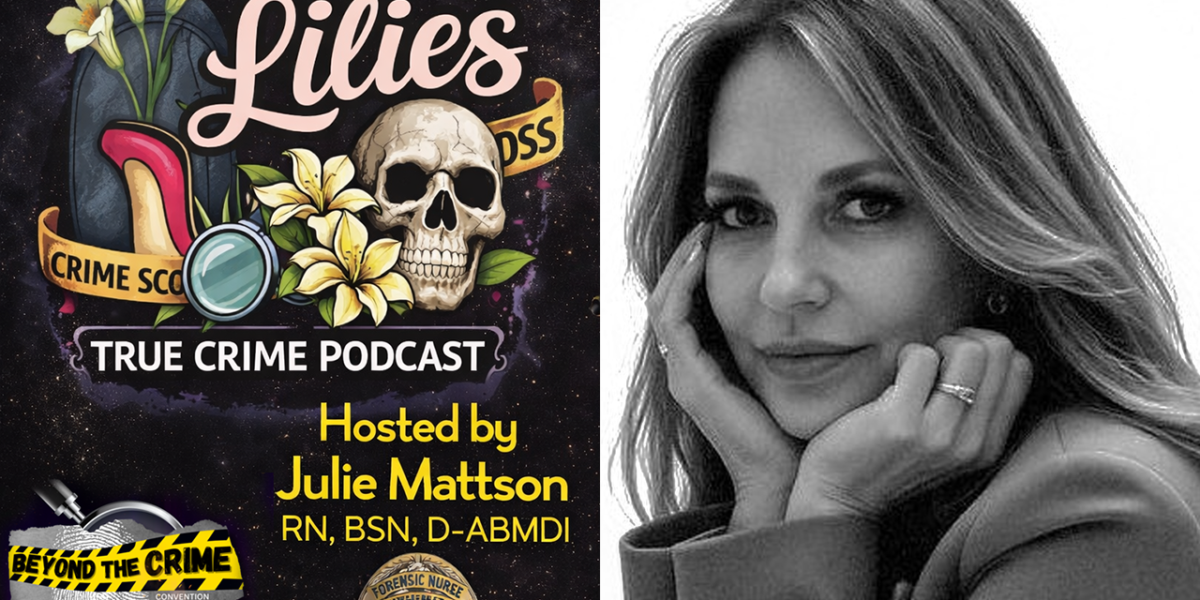
In this episode of Pushing Up Lilies, I’m coming to you live from Beyond the Crime 2026 at the Isleta Casino and Resort! And instead of focusing on just one case, I’m sharing something a little more personal… and a lot more unpredictable.
I take you through my journey from the emergency room to becoming a forensic death investigator, and how my perspective on death, trauma, and investigation completely transformed along the way. This career wasn’t something I ever imagined for myself, especially as someone who once feared death so deeply, but it became one of the most defining parts of my life.
From there, I share some of the cases that have stayed with me over the years, the strange, the shocking, the heartbreaking, and yes… even the ones that make you shake your head and say, there’s no way that actually happened.
Because in this field, no two scenes are ever the same.
We’re talking about everything from unexpected discoveries and bizarre death scenes to the realities of working with families on the worst day of their lives. I also open up about the emotional weight of this work, the importance of mental health, and how I learned to balance compassion with professionalism in situations most people never experience.
This episode is raw, real, and at times unbelievable, but it’s also a look behind the curtain at what death investigation truly looks like, beyond what you see on TV.
And if you’ve ever wondered what it’s really like to do this job…
this is one you won’t forget.
* Listener discretion is advised.
EPISODE TRANSCRIPT:
00:06
Welcome to Pushing Up Lilies. I’m your host, Julie Mattson. Pushing Up Lilies is a weekly true crime podcast with spine-tingling, unusual, and terrifyingly true stories from my perspective as a forensic death investigator and a sexual assault nurse examiner.
00:24
Do I have some stories for you? Are you ready? Hey, this is Julie with Pushing Up Lilies again here for another episode. I’m happy to be LIVE, here at the Isleta Casino and Resort, and we’re at Beyond the Crime.
00:43
So, this is really exciting. And I thought instead of like telling one specific story, I would kind of share a little bit about my career and then tell some stories that kind of stand out because some of them are strange, really strange.
00:57
So, if you told me, though, years ago that I was going to be around death, I would have said there’s absolutely no way. I was terrified of death when I was a kid. I was afraid of dying. Every day I thought that might be the last day I saw my parents.
01:09
So, it was really weird. Like I obsessed about it. So, it was really crazy that I ended up in this career field. I worked in the ER for a long time. I was a brand new nurse. And of course, I wanted to fix everything and help everybody get better and stabilize them.
01:24
And so, when someone died, I felt like a failure. I would go home and kind of feel defeated. Like, what did we do wrong? What could we have done different? It was just heavy, you know, just a heavy feeling.
01:37
I always felt like we’d done something wrong, even when I knew we did everything right. So it was, it was a weird guilt feeling. But I learned fast in the ER. It’s very fast, unpredictable. And we never knew what we were going to get.
01:50
Saw a lot of trauma, did a lot of CPR. And we still had to be calm, which was learned. Because at first, you just want to panic because everything’s going fast and people are hurting and screaming and crying and pushing their call bell.
02:06
And it’s just, you start to get frantic, but you can’t ever show it. So, we always had to stay calm, but it really built confidence and resilience in me and exposed me to a lot of situations that people never see.
02:20
CPR was always hard, especially when it was someone I knew. Many times, in a small town, you end up doing CPR on, I did CPR on my doctor. Like, yeah, he coded comes in, you know, and it was like, oh my God.
02:33
And he did not make it. And again, you just feel because I knew his family. I knew his dad. I knew his kids. But that silence is really heavy and is really hard for me when they gave up the fight. We had to give up the fight.
02:49
But I always saw people in their worst day, and I saw trauma and fear and illness and a lot of resilience. But I had to stay focused, and I found myself asking questions like beyond treatment. So that’s when I realized maybe I would be a good investigator, you know, like I want to be nosy, but we always want to ask questions that are inappropriate.
03:13
And so, when I got a job as a death investigator, it was my job. So, I could be nosy and I was getting paid for it. So, it was kind of cool. But I remember the first time I saw a death investigator come into the ER when we lost a patient.
03:26
And I think it was a hanging. He’s 80 years old now. So, he’s still alive. But I asked him, what can I do to get your job? And a lot of people ask me that now. And he’s like, go to all the trainings you can.
03:38
You don’t have to pay a million dollars but get a certificate that says you learned and keep it behind your resume and just keep building it. When people see your desire to learn and the fact that you’ve educated yourself, they will know that you’re serious about it and take you seriously when you apply for a job.
03:54
So that’s what I did. But I guess when, I mean, the first idea of working a death scene made me very uncomfortable because it just felt heavy, kind of like the ER, but it’s such a different situation, obviously.
04:09
But we used to have criminals or people from the jail come in and when they spit on us, we shoved a washcloth in their mouth. Now you can’t do that. You know, that’s considered assault. But my patients don’t spit on me anymore, you know?
04:22
So, it’s like, I was like, oh, maybe, I mean, they don’t yell at me. They’re not mad. You know, I can’t hurt them. So, it’s a lot different. I guess one of the biggest misconceptions, though, about death investigation is that it’s depressing or really dark.
04:37
And it can be, but a lot of people assume that every case involves tragedy and violence. But in reality, a lot of deaths are natural and a lot of them are expected. Then again, I had suicides where the family would say to me, and it was always heartbreaking, I’m so glad he did it now because I don’t have to worry about it happening later.
04:58
And that always just broke my heart because I realized that they just lived in constant fear of when it was going to happen because there were so many suicide attempts, you know, in the past. So, it was just, I don’t know, there’s still heaviness to it, but it’s a different kind.
05:13
But even in those situations, we always had to do an investigation just to make sure that there was no foul play and accuracy was very important. So, nursing taught me that, how important documentation was and asking the right questions.
05:29
But over time, I stopped seeing death as failure and started seeing it as information and just learned how to investigate and learned what questions to ask. And I guess one thing that got me is that I just remember when I worked in the hospital, I had little patients that would fall all the time.
05:48
And then I realized as a death investigator that little old people don’t recover from falls. You know, when they break a hip, usually it’s downhill from there. The importance of taking care of them in the hospital became even more visible to me.
06:04
There’s a lot of emotion to the work too. A lot of cases stay with you, even when you’ve worked the scene and you’ve been there and you get to know the family, and you talk to them. And so mental health is important in this profession as far as making sure that we kind of debrief after certain cases because we’re exposed to so much.
06:27
I mean, you see so many things. So healthy ways to decompress. My husband will tell you he never wanted to hear my stories. So that’s why I started the podcast because I needed to talk to somebody to kind of like debrief myself.
06:41
And my kids would be like, mom, don’t tell, you know, don’t tell me, mom. I don’t want to hear, you know, worst case scenario. So, taking care of yourself definitely allows you to be better at your job.
06:52
So that’s something we all had to learn. A lot of people ask me how I handle it and if it scares me or makes me sad or why am I always happy? And that was hard for me because I’m a happy person that likes to make people happy and comfortable.
07:08
And that was what I did in the hospital. And so, you know, you can’t walk up on the crime saying like, hey, y’all, you know, like you just can’t, I mean, you can be nice, but you don’t want to look like you’re trying to be disrespectful.
07:19
And so it was that part was hard for me because you got to be friendly, but there’s like, you’re walking a line. But looking back, my whole perspective has kind of changed. It just kind of, I learned to focus more on what I needed to look at and not so much the fact that there’s this dead body in front of me.
07:40
But I mean, I went to the crime scenes, I take photos, document everything for the doctors so they can accurately determine the cause and manner of death. And so, there’s a lot to it and you have to be pretty precise because doctors aren’t always nice if you mess up, you know?
07:57
So, we always hated to get a call from the doctor after a scene. It’s like, what did I do wrong? You know, it’s just this terrible, terrible feeling. But there is a lot of respect for the family. Everyone used to always say, you don’t even deal with real people anymore.
08:13
But the fact is I’m dealing with family members who’ve just lost somebody and it’s many times the worst day of their life. So, I mean, even in hospice cases, you know, it’s difficult because even though you know it’s going to happen, it doesn’t make it easier always.
08:29
A couple of stories. I’m going to tell y’all just about a few of my stories because some of them are really kind of crazy. I had a lady die. She was on hospice and her family, as we do, had to go through all of her stuff in the attic, cleaning out the house.
08:46
They found a rubber-made tub, and it had a child’s bones in it. And of course, they called the medical examiner’s office, and they were like, oh, we’re going through mom’s stuff, and we found this, these bones.
09:03
And so in talking, they said that when they were younger, the mom said that their younger sister had gone to live with their aunt, and they never saw her again. And I guess they assumed the aunt was taking care of her.
09:18
She was fine. Mom was okay with it. So, they’d never really asked any questions. Anyway, we did DNA on the bones, and it was their sister. And so, there was no trauma noted to them. And so, we don’t know like how she died.
09:35
But I mean, we don’t think the mom killed her, but maybe she panicked. Maybe she passed away or who knows, you know, drowned in the bathtub. We will never know because it was bones. There were no tissue or anything.
09:47
So, they really couldn’t do any testing, but it appeared to be natural. But could you imagine this like discovering bones that you know belonged to your younger sister that you thought had lived with your aunt for all those years?
10:00
So, it was crazy. But we’ve also had people call us and say we found bones. Someone found a coffin one time and called us. It had bones in it. And it was like behind a restaurant or something. Anyway, it was a plastic skeleton that someone was using as a Halloween, you know, but they panicked when they saw it because they thought it was real.
10:22
So, it was kind of the calls like that that come in are crazy. I had one scene where, and I tell this one all the time because it’s kind of one of my favorites, but kids doing drugs in a hotel. This is when I worked in Houston and one of them became unresponsive.
10:39
And so, they panicked. And they, you know, have the wooden base around the bottom now. And I don’t know how many times before they did that, I used to kick clothes under the bed at a hotel and then leave without them.
10:52
So, I always thought that was the reason why they started putting the wood base around the bottom of the bed. I don’t know if that’s the reason or not. But if you raise the mattress and the box spring, there’s just kind of a wooden box under there.
11:05
Well, they panicked when she became unresponsive and they threw her in there and they just dropped the mattress and mugs and then they went home. So yeah. Three weeks went by and they called the hotel and they said, hey, our friend, I’m going to say Susie, wasn’t Susie, but our friend is under the bed in room 503.
11:27
Of course, they thought it was a joke at first, and they called the police to come out and knock on the door. There’s someone sleeping in there because it’s, you know, it’s a hotel room. And they’re like, sir, you need to step out.
11:41
And of course, he panicked. What did I do wrong? Why are y’all here? And he comes out of the hotel room, and they raise the bed and lo and behold, that lady’s under there. So, she had been there for like three weeks.
11:54
I know. So, she was not decomposed because she was in that enclosed area and the oxygen couldn’t get to her. And so, you couldn’t smell her in the room. And you know, in a hotel, I don’t know if y’all are like me, but like I jack the airway down because I’m not paying the electric bill.
12:09
So, I mean, like, it’s going to be like 65 in my room. So, everybody keeps it really cold. So, it’s kind of like, kind of like a morgue, you know, I mean, in my room anyway. So, she was under the bed. So, the police called me and I was just like, this whole story is just crazy.
12:24
Of course, the poor man that was staying in the room at the time, they offered him like free stay for life or whatever, but it was like the Smile Motel. Like it wasn’t the Renaissance or, you know what I mean?
12:35
So, it’s like, he didn’t want to go back there ever, especially after he knew he’d slept all night in a bed that had a dead body under it. So that story was kind of crazy. Another one that I will never forget is many times people donate their body and they can donate tissue, not organs, or to donate organs, you have Stalin Life Sport, obviously, but she was donating tissue and bone.
12:59
And so, the funeral home was driving her body to Colorado. And I’m guessing in my mind, I see this young kid driving this van, the radio really loud, blaring. At some point, he hit the brakes and she slid out the back window.
13:14
Okay, so she was in a body bag, and she was, you know, strapped to a backboard. And the police called me and said, we found a dumped body. And I’m like, okay, that’s really nice criminal. They bagged her and everything and put her on a backboard for me.
13:30
I mean, what else could you ask for? No, I looked at the backboard. I saw the name of the funeral home. I called them and they said, oh, she’s on her way to Colorado. She donated her body. And I said, no, sir.
13:43
She’s on the side of the highway. So, my first thing was like, I was really glad that when she slid out, she landed on the backboard instead of body down because she would not have slid off the road like she did.
13:57
She kind of slid into a ditch, which, you know, it would have been horrifying if she had landed body down and then got hit by a car because it was dark. So, the hardest thing, though, was all she had on was a bracelet.
14:12
She died in hospital, natural causes. She was like in her 80s, but she had a bracelet on with her name. But if I can’t look at an ID and a person and know for sure that it’s them, I have to bring them in as an unidentified person.
14:24
They have to be fingerprinted. So, we had to do that. So, the hardest thing was to call the family after they’d already gone through the death, agreed to donate the body. They thought everything was up and up.
14:37
She was on her way to Colorado. And then they find out she slid out of the van, was on the side of the highway. You know, they were glad to know that she wasn’t hit by a car, you know. But it was really a hard phone call.
14:50
Of course, they were very pissed off at the funeral home for not taking care of her because you do trust that they’ll do that when you put your loved ones in their hands. But that was the strangest story.
15:01
And I laughed because the police actually thought she’d been dumped. And I just thought, no, this is not a dumped body. They don’t bag them for you. I mean, you know, never happens, never happens. A couple of really funny, I want to make sure there’s no kids around.
15:16
I mean, they’re funny, but I mean, if it’s your thing. I had gone to a scene, and I know the officer was like, there’s a slight, like he’s like, I don’t know how to tell you this but just come look at it is what he said.
15:31
So, I was like, okay, what is going on? I get there and this guy had a vacuum cleaner on his penis, and it was on. It was on. So, I’m like, ooh, you know, and his mom found him, which, I mean, you could just picture it, you know, like his mom walked in, found him.
15:51
He was dead with a vacuum cleaner attached and it was still on. And of course, I found heroin in his pocket. And that’s why my hashtag is ‘Die Naked’ because it’s always easier for me when you die naked.
16:04
I don’t have to document your clothing, and I don’t have to empty your pockets, but because sometimes there’s drugs in there, right? Of course, I’m wearing gloves. But so yeah, there’s that. Scenes like that, just really odd.
16:14
And the police, he was embarrassed to tell me, like exactly what was going on. He’s like, um, it’s just different. Like just get over here, you know? So, I was like, okay, of course I had to turn it off and remove it and, you know, all the things.
16:27
So yeah, it’s very, it’s very different. I remember one time too, a guy had hung himself. I know the stories are crazy. You think you see it all? He hung himself in the closet and there was a lot of like leather and chains and stuff in his closet.
16:43
And so, the cops were all kind of big guys. And part of my job is to help my transport move the body. So, we had to get him out of the closet. So, I go in there. I start kind of pulling stuff out of the closet to make it easier for us to get him out.
17:00
And there’s a sex doll. And it was heavy. It was filled with sand. It was super heavy. I didn’t expect that, you know, so when I grabbed it, I pulled her head off and I’m like, here. And I just threw it out of the closet.
17:13
And they’re like, oh my God, you broke it. And I’m like, whatever, you know, so just like weird stuff like that. And so, we were always careful. You know, we never laughed about stuff in front of the family because you had to be respectful.
17:26
And if they hear you laughing just because that’s kind of how we dealt with the trauma amongst ourselves, you know, they would definitely think that we were being disrespectful in some way. So, I think one time someone heard the police laughing and the mom had said something to me.
17:43
And I said, that’s just kind of how we deal with it, you know? And so, we’re not joking about your son. We’re just kind of trying to get through this, you know? I know it’s way harder for you than it is for us.
17:53
And even though we see this every day, it’s still difficult. He was a teenager and he had overdosed. And so it was just, it was a touchy situation, but we always had to be careful because occasionally news media would show up, like if it was a car accident or, you know, a helicopter would fly over and you can’t be out there laughing and cutting up and smiling, you know, because then it’s like you’re on the five o’clock news.
18:21
Why does the medical examiner think this is funny? You know what I mean? So, you’re really being watched all the time. Of course, I remember the first time I was on the news. It was so dumb. It was like my first week at work in Harris County.
18:34
My dumb butt thought I should wear white pants to work. House fire that day. Bad idea. I’m covered in soot. And of course, the news media shows up, and I like look like, you know, terrible. So, it’s funny.
18:49
But they do, everybody watches us and everybody hears what we say. And so, we always have to be really careful that we don’t sound disrespectful, that we don’t say anything inappropriate when, you know, our voices are able to be heard by other people.
19:06
Many times, we would have like decomposed bodies, people that are floating in the water, you know, they’ve been missing for a couple of days. They jumped off a boat. They never resurfaced. I always say it’s kind of a hold my beer and watch this moment, you know, where, you know, friends on a boat.
19:24
And the weird thing is a lot of them could swim. That was one of the questions we would ask in a drowning, you know, were they a good swimmer? And many of them were like competition swimmers in high school.
19:35
So, it’s always like, what happened? You know, and was it the alcohol? Did they have a medical event? But the bodies eventually would float to the top as they bloat, you know, and start to fill with air.
19:47
And my husband makes fun of me because I used to always say, why couldn’t they just surface in the next county? Like push them over there so I don’t have to work the scene. But many times we’d be out on boats, with like, Texas Parks and Wildlife, you know, helping them look for bodies and riding around in the middle of nowhere in a side-by-side, you know, helping get the bodies.
20:10
Lots of bugs, lots of smells. I usually would come home smelling like DEET and sweat and decomposed bodies. And most of us shed our clothes in our garage before we ever walk in the house. They go straight into the washing machine, sometimes straight into the trash, to be honest, you know.
20:28
And I wore scrubs a lot because I didn’t want to ruin my good clothes, but we had to look good. So that was always important too. But I remember a couple of times we had people that were found by their neighbor or the neighbor would be like, I haven’t seen my neighbor in a long time.
20:47
And so, they’d call the police for a welfare check. And one in particular, there were so many flies on the window that it looked like a black curtain. It was covered in flies. And so, you go in there and of course you stir them up when you start moving stuff.
21:01
And you really don’t want to inhale really deeply when there’s a bunch of flies hanging around because I inhaled one one time after it had been on a body, which kind of, but it just kind of hung there.
21:13
And I could not, I know, I was like, I couldn’t get it up or down, you know, I was like clearing my throat and drinking and coughing and I could feel it. And I’ve inhaled a couple of gnats and cause when you move the body, all these bugs are, you know, flying around.
21:30
And I never really wore a mask. The smell never bothered me because I was so used to it working in the emergency room. But the police would be like all decked out, looking like marshmallow men, you know, in all their like Tyvek suits and they’d have on the mask and the hat.
21:45
And I’m like, y’all are wusses, you know, like walking in there, my heels up going, y’all are crazy. The decomposed bodies were my favorite. I loved going on decomps. And I think the reason is because the injuries were not visible.
22:01
And so, it challenged me more because part of my job was to roll the body and look over the body for trauma. And so, it challenged me a little bit. And it’s hard to see trauma when somebody’s been in the water for three weeks.
22:15
So that’s why all of those deaths always went to the medical examiner’s office. They always got x-rays to make sure that there were no like projectiles in the body, making sure there were no bullets. And because trauma is hard to see.
22:29
It’s hard to visualize on a body that’s decomposing like that. So yeah, very glamorous job. And it’s weird because I never thought that I would like it. And everybody kind of thinks it’s kind of a man’s world.
22:45
But honestly, most of the investigators that I worked with were female. I think our stomachs are stronger. I don’t know. I just think we have stronger stomachs. I am starting to develop like an educational program because I have a lot of nurses reach out and want to know how to get into forensics because we’re all, everybody’s interested, you know, everybody watches the shows.
23:09
Everybody’s a detective, you know, right? So, I am developing an educational program so that nurses can train in forensics and get continuing education. Because many times we would have a homicide come into the ER and they would bag the hands and wash the body, you know, and they thought they were helping us, but they were destroying evidence.
23:30
And so, I realized that they really need to be educated. And there’s not many places that actually teach them those things. The hospital claims to, but the hospital doesn’t really know the policy either.
23:44
So, we had a lot of evidence destroyed because people weren’t educated. So, I decided that that was something that I was going to do. Yeah. I’m sorry. I’m just now working on it. So, it’s probably going to be, I don’t really know.
23:59
I mean, I’m sure that the name of the podcast will probably be on it somewhere. But yeah, it’s not developed yet. But it’s going to be one where you can get some of the trainings free and then you can upgrade to get additional training based on, you know, what you need to know.
24:15
It’ll probably be where you can get a certificate afterwards, just so that they can prove they’ve had the training and, you know, kind of know what’s going on and what they’re doing. So, but yeah, everyone I worked with, most of them were retired law enforcement and they knew more about guns and weapons than I did, but I knew more about medical history.
24:37
I could go through someone’s medicine cabinet and know by the meds they were taking what their medical history was. So it kind of made it easy as a nurse, but then I wasn’t super educated on guns, you know, so it was nice because we could always bounce questions off of each other and kind of work together as a team and be as accurate as we could in helping because all the information we gathered and all the pictures we took actually helped the doctors determine the cause of death.
25:08
So, it was very important. So that’s why we had to stress all the time to the police. We need pictures. Like I’d got on an accident one time, and they were sweeping the scene, and they’d already put the car on the trailer to try and haul it off.
25:24
And I’m like, what are y’all doing? And, you know, it’s like, I can’t get pictures now. Of course, I had their pictures, but we got in trouble when we didn’t have our own. So, we had to kind of train law enforcement not to move anything until we get there.
25:40
So, but yeah, interesting career field. I just retired about two months ago from the medical examiner so that I could do the podcast more and use it as a platform for education. And then I own a med spa too.
25:56
So that’s a whole nother thing. But we do have a bunch of merch over there. If anyone likes skulls, it’s all on the merchandise. Does anybody have questions or yes? What is [Inaudible] ?
26:14
Probably on like terrain. You mean as far as just like in general? I had to walk like up the side of bridges and kind of get in the water sometimes to get the body out. So, I always carried rain boots in my trunk because I never knew when I was going to need them.
26:31
You know, it’s like they’re partially submerged. You know, you got to get in the water and help pull them out. I had a homicide once where she was weighted down with concrete, like slabs. So, I had to like pull all the…
26:45
I was in the water, like in this river, pulling concrete slabs off of her. And I think they had cut her up and put her in a cooler. And so, we can’t, of course, as investigators, we’re supposed to manipulate the body as little as possible.
27:01
So, our job was really just to make sure it was human, which many times we would find, people would find coolers with a dead deer in it. We would be like, send us a picture of the bone. And then we would send it to our anthropologist.
27:14
And once they determined it was human, we got involved. So yeah, probably the terrain, you know, it’s just like never knowing what you’re getting into for the day. Like never knowing, am I going to need my rain boots?
27:26
And am I going to have to put on my waders to get in the water and pull people out? But it was always fun because no, no two days were the same. You know, every, you know, you never knew what you were getting into.
27:37
And we’d always get mad at each other because whoever’s turn it was for a scene, it’s like, dang, you always get the good ones. You know, like, I wanted that one, you know, and sometimes we’d go together because we both want to want to see what happened.
27:49
And, but yeah, it’s a super interesting job. And I always encourage nurses to do it because I feel like nurses are good at it. Like, you know, we’re good at recognizing trauma and recognizing certain disease processes and that kind of thing.
28:04
Any other questions? Yeah. Uh-huh. Do you recall all of your stories and cases, and could you ever tell me of how man? You know, I did for a while and then I quit doing it because there were so many.
28:20
And then I’ve worked for three different offices. So, when I worked in Harris County, I mean, we were super busy. There would be times when we would leave for a scene and we would get sent from that scene to another one.
28:30
So, it was like the whole day was just running, running, running. By the time we got back to the office, we were so busy typing reports. We would work, you know, three hours overtime. But I worked in Dallas County.
28:40
I was kind of administration. I was deputy chief there. And I only stayed a year because I, that job, it was terrible. I don’t like admin anyway. I’m not one to like sit behind the desk. I really wanted to be out in the field working with the families, looking at the bodies, doing what I trained to do.
28:57
I wanted to investigate. But no, I don’t know how many. I mean, and even for a while when I worked as a sexual assault nurse, I was keeping up with how many kids and adults that I had done evidence collection on.
29:08
And I just kind of lost track. But I wish I had. I mean, I can say thousands. I mean, but I just, I wish I knew the number. Because there for a while I was keeping up with it on my resume so that, you know, I always kind of knew I’ve investigated this many.
29:23
But yeah, that’s a good question. I’m kind of mad that I didn’t. Now, now that you say that, I’m mad. Yeah. How typically long would you investigate something like that? And then you just say, okay, yes, it is a murder?
29:37
So, we’re talking about. So, the police would get called first, naturally, and they would kind of set the stage for me. By the time they called me, they kind of had figured out, you know, what was happening.
29:50
Usually, they had talked to other family members already and they kind of knew there was conflict or what was going on, phone calls that had been made and kids picked up and all the things. So many times, they had that information already when I got there.
30:05
My job was kind of just to come in after that, take photos and then remove the bodies. But they would look at like trajectory and those types of things. So, I never really had to be the one to determine that.
30:18
Of course, the doctors would determine that for sure when they got to the medical examiner’s office based on the injuries because you could tell which one, like how, with the distance they were shot from and that kind of thing.
30:31
So we had a lot of them. How typical is it to not have a date of death? Very. One big misconception is that we can always really pinpoint the exact time. And a lot of people would call our office and say exactly what time because they felt guilty for not being there, you know, and so many times it was like, if I’d only gone over there yesterday, you know, like, could I have saved her or whatever.
30:59
And so a lot of it. Typically, we can just based on like rigor, lividity, and like the amount of decomposition. But so many things come into play when it comes to that. Yeah, I mean, the temperature, their health condition, their weight, their age.
31:19
Yeah, the temperature in the room, you know, whether, was there a fan blowing on them? Cause then we have a lot of drying effect, you know? And so, it was really hard to pinpoint. And so that was important in homicides when they’re trying to pin down when an event happened or who did it and where they were at that time.
31:37
But in regular deaths, we really didn’t. And I always tell people our time of death we use was the time that they were found. And so that was always hard for people. You know, there was a found time, you know, and a pronounced time.
31:52
And I understand it was hard for families, and they just wanted to know that they couldn’t have been there. They couldn’t have done anything. And so that’s a lot of reasons why they would call and ask that question.
32:04
But it’s just, it’s so hard to pinpoint. We don’t have a time of death for my son. Oh. Oh, no. Was he at home or? It was murder. Oh, okay. Okay. They can’t tell us which day. Right. Right. I mean, I would think that they could get pretty close, but it’s just hard to know the exact.
32:36
There’s a lot of cover-up in it. Yeah, and I find that, I mean, I hear that a lot too. Did you see any of that? Actual cover-up. No, because, I mean, if it happened, it happened when I wasn’t around because I would have like, said something.
32:50
You know what I mean? I wouldn’t have been okay with it. And we worked closely with the police, but we were not part of the PD. So, it was like the body was mine and the scene was theirs. And the doctor would try to determine, you know, based on the condition of the body or whatever.
33:09
But I’m sure there is. I mean, I hate to say that, but I mean, you hear too many instances where it almost seems obvious, you know? But no, if they ever, and I think they knew too, the people that I worked with anyway knew that if they ever tried to do that and I was around, they weren’t going to get away with it.
33:26
Yeah, I was not going to let that happen. But, you know, when I see them whispering, I’m kind of like, you know, what’s going on over there? We have the cam footage. My husband watched it. I have not.
33:38
What did they say? [Inaudible]. Okay. So typically, what is that? 6 to 8? Yeah. And the thing is, too, that once it sets in and then it dissipates. So that’s what makes it hard.
33:53
You know what I mean? And that’s what makes it hard because it’ll set in and then it’ll go away. So, it’s like, are we, you know, right? Did you catch the front end or the back end? So that always made it so hard to determine.
34:08
Uh-huh. At the end of August, so you know, there’s heat and stuff like that. Convincing us that they were well preserved, because it was cold out at night. Uh-huh. There are so many things that didn’t make sense.
34:22
They did not preserve the crime scene. They did not, yeah. Really? Like, they didn’t block it off and they weren’t. Oh, man. Let it sit in wide open. Oh, my gosh. You’re just handled really badly. Yeah.
34:37
And, you know, I don’t know. I feel like if they just, I always get mad because, I mean, not just in death scene investigations, but every job. It’s like if everybody would just do their job, like it would make our lives a lot easier.
34:51
It’s so aggravating. But, no, when I saw people like whispering, I’d be like, what are we whispering about? Why are we whispering? Or a lot of times, you know, because I’m female, they try to like, like, you don’t need to know.
35:03
And I’m like, no, this is an investigation and I am an investigator and I need, I do need to know. So, you may not want to tell me, but I mean, I need to know. It’s important because my doctor needs to know.
35:15
And he’s going to wonder why I don’t know. You know what I mean? Like it’s all a, but yeah, that’s so hard. We’ve done everything we’ve tried to get. There’s body cam footages. They don’t release. They won’t give us, they won’t give us our 911 call.
35:31
Oh my gosh. Do they, I mean, I always thought they didn’t have a choice. They can just keep them from you? I mean, there are transcripts, but 90% of them are redacted. That is so. How long ago was that?
35:44
2024. August 2024. Oh, so not that long ago. And he was six and your Ex?. Yeah. Wow. I mean, I always think about, you know, you always hear situations where the video’s been deleted or we can’t find it or, you know, and that always aggravates me.
36:03
I’m like, are we not treating these cases carefully? Like, the crime, the actual crime scene, there’s a burn barrel and his computer, laptop, and all five of his cell phones were burned in the middle.
36:16
Oh, my gosh. So, what is going on there? Yeah, what is going on? You would think. They didn’t. Wow. Was it a small town? I just have to ask. Was it a small town? Was… see, and when we had something happen in a small town, a lot of them would call in the bigger cities that had like the crime scene units and they did not.
36:40
They try to handle it on their own. I mean, we had one in a small town where a kid, he shot himself and he staged it to look like he was cleaning his gun, and the gun went off on accident. He was like 16.
36:51
And come to find out that it was a suicide, he had stuck the barrel in his mouth. And so, they could, you know, from all the injuries, the doctor was able to determine that it was a suicide and the barrel was in his mouth, which you don’t put it in there when you’re cleaning it.
37:06
But the sheriff had already cleaned the weapon and gave it back to the family because it was a, you know, it was a small town. And even though, and he was in charge, he was like in charge. So that was the scary thing is that he trained everybody else to do what he thought was right and it was wrong.
37:23
So, I know. And so, I just don’t think that they get, I mean, I hate to say that out loud, but they just don’t get the training that they need. And they may not have, I mean, not to make excuses, but they may not have the money to send their officers.
37:37
But if I was an officer and I wanted to be good at my job, I’d send myself. You know what I mean? Like I’ve done that before where my boss is like, no, we can’t afford to send you. Fine, I’ll go by myself because I want to know like this is training that I can get and I want it, you know?
37:52
So. Yeah, and I hate that. And y’all, I’m sure you got an attorney or no, right? Yeah. Actually, Karen said she’s going to help us too. Oh, good. That’s awesome. I hate that, though. I mean, that’s one thing about living in the city.
38:12
I mean, I hate it. Don’t get me wrong. I don’t like, you know, traffic and crowds, and all the things. But usually, they have the better investigators that are a little more seasoned, that kind of know what they’re doing.
38:25
And some of the small towns are embarrassed to say that they don’t know what to do. And so, they don’t do the right thing. They’re mad. They’re so mad at me. Oh, really? I don’t blame you. I would be too.
38:38
Called out every single person on there. I’ve been all over the news. It was all over Michigan. I don’t blame you. I would be, yeah, because it’s just. They were laughing at me on some of the body camp footage because I was so crazy.
38:54
Oh my gosh. But I was the crazy one. And that is so, that’s so aggravating. Ellen didn’t have a job, couldn’t drive. Oh. And then you’re the crazy one for being upset because you lost your child. That’s ridiculous.
39:12
Yeah, yeah. Oh, I hate that for you. I’m so sorry. Oh. Well, maybe they can help you get answers. That would be awesome. Well, I hope y’all get answers. You’re welcome. You’re welcome. Thank you so much for joining me today on Pushing Up Lilies.
39:31
If you like this podcast and would like to share with others, please do me a quick favor and leave a review on Apple Podcast. This helps to make the podcast more visible to the public. Thanks again for spending your time with me and be sure to visit me at pushinguplilies.com for merchandise and past episodes.