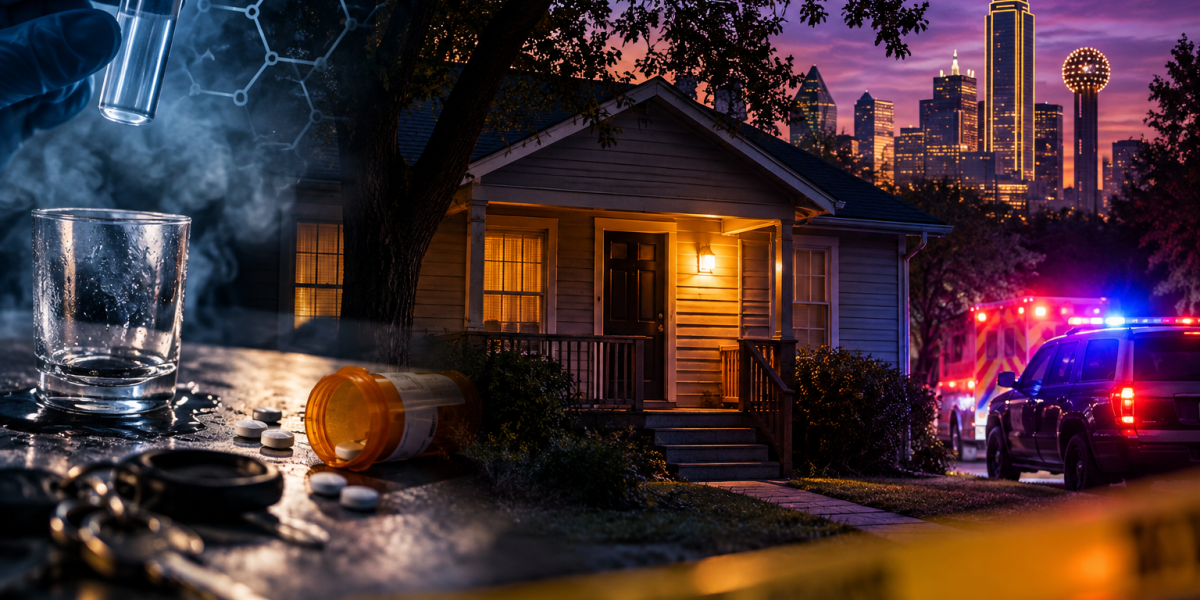
Four people found unconscious inside the same house. Three dead. One survivor. No obvious injuries, no clear explanation, and weeks later, still no publicly confirmed cause of death.
When I heard about what happened on Berger Avenue in South Dallas, I immediately thought about the questions I would be asking if I were called to that scene.
On August 31, 2026, emergency responders discovered four adults unconscious inside a residence. Carlos Alonso Celorio, Martin Rodela Jr., and Katoya Deshae Ferrell were pronounced dead, while a fourth person was transported to the hospital in critical condition.
Neighbors reported activity at the house earlier that day, and speculation quickly began. But as a death investigator, I know how dangerous it can be to settle on an explanation before the evidence supports it.
In this episode of Pushing Up Lilies, I’m taking you inside the investigative process to explore what happens when multiple people become unconscious in the same environment. What did they have in common? What might the scene reveal? And how could the person who survived help investigators understand what happened?
I’ll walk you through how I would approach a case like this, from evaluating possible environmental hazards and documenting the original scene to examining food, drinks, medications, witness accounts, and medical evidence. We’ll also discuss why autopsy findings, toxicology, and the survivor’s hospital records may become essential pieces of the investigation.
One of the most important lessons from my years in forensic death investigation is that a scene doesn’t always tell the story you expect. Something that seems insignificant when you first walk through the door could eventually become the detail that changes everything.
As of this recording, the final causes and manners of death had not been publicly established, and authorities had not classified the deaths as homicides. I wasn’t involved in this investigation, and I’m not here to turn speculation into fact.
Three people lost their lives, another survived, and their families deserve answers grounded in evidence.
What happened inside that house on Berger Avenue?
That’s the mystery we’re examining this week.
Content Note: This episode discusses unexplained deaths, potential toxic exposures, and death investigation procedures.
EPISODE TRANSCRIPT:
00:06
Welcome to Pushing Up Lilies. I’m your host, Julie Mattson.
00:10
Pushing Up Lilies is a weekly true crime podcast with spine-tingling, unusual, and terrifyingly true stories from my perspective as a forensic death investigator and a sexual assault nurse examiner.
00:24
Do I have some stories for you? Are you ready? Hey, guys. We’re back for another episode of Pushing Up Lilies. So glad that y’all could join me.
00:36
I am hurrying and rushing to get ready for this murder mystery dinner. Buy your tickets soon. Again, it’s on Eventbrite, so don’t forget. It’s gonna be October 10th, and it’s gonna be so much fun.
00:48
I’d just hate for y’all to miss it. Tickets are limited. We’re limiting it, I think we said, to 70 people or so. So be sure and get online and get ’em. I wanna talk to y’all this week about a story.
01:01
It’s here local, and it’s kinda crazy because I remember my old coworkers talking about it, but I didn’t get to be in on it.
01:09
And so that’s the hardest part for me now that I don’t have that job is to not know what’s happening.
01:15
Because used to, when something like this happened, everyone would call me and be like, “What’s going on?” And until someone died, I didn’t know, so they would know just as much as I would if they turned their scanner on.
01:28
But anyway, this is a story about three people dead and one survivor, and we’re gonna talk about what happened on Berger Avenue.
01:39
So, four people are found unconscious, and they’re all inside the same home in South Dallas. Now, three of them are dead, but one is alive, and there’s no obvious traumatic injury.
01:53
Police reportedly don’t find any obvious drug paraphernalia.
01:57
There’s no gas leak or anything like that, and investigators initially find nothing at the scene that immediately explains why four adults became unconscious at the same time and the same place.
02:10
So, three weeks later, we know the names of the people who died, but we still don’t publicly know what killed them.
02:18
And from a death investigation standpoint, this is exactly the kind of scene where what you don’t know matters just as much as what you do know, and this is what made the job so fun.
02:30
So, when multiple people become ill or die in the same environment, you have to ask a very different set of questions. What did they breathe? What did they eat? Did they drink something?
02:43
What medications or what substances did all of them take? And how long were they together? Who became symptomatic first? Because you know someone did. And were there other people there earlier?
02:55
Did anyone leave before the emergency, before the breathing stopped? And most importantly, what did these four people have in common?
03:05
So today we’re gonna go inside the investigation of the Berger Avenue deaths in South Dallas.
03:11
I’m gonna walk you through what we know, what we don’t know, and what a forensic death investigator would be looking for in a case like this. Now, again, I was not involved in this investigation.
03:24
I’m discussing the case from the perspective of my experience as a forensic nurse death investigator using publicly available information and established death investigation practices.
03:37
So, despite all the speculation surrounding this case, there’s one thing we have to remember. These deaths remain unexplained publicly, and unexplained doesn’t necessarily mean suspicious.
03:52
It doesn’t mean an overdose. It doesn’t mean someone was poisoned. It means that the investigation simply is not finished. So, let’s talk first about the call.
04:05
Monday, August 31st, 2026, Dallas Fire Rescue received what was described as a medical emergency call at a home in the 2700 block of Berger Avenue.
04:16
Now, this is near Malcolm X Boulevard in South Dallas. Univision reported the fire department received the call shortly after 12:39 in the afternoon.
04:27
Now, Dallas police said officers responded around 1:12 after Dallas Fire Rescue requested assistance. Inside the house, there were four unconscious people.
04:39
Dallas Fire Rescue determined that three of them were dead, and the fourth person was transported to a hospital in critical condition.
04:47
Dallas police documented the case as an unexplained death investigation. Now, that wording matters because at that point, police weren’t really publicly calling this a homicide.
04:59
They weren’t calling it an overdose, and they weren’t publicly identifying any kind of a gas exposure.
05:05
They just knew they had three deceased people, another person who was critically ill, and no established explanation at all.
05:14
Now, we now know who the three people were: 26-year-old Carlos Alonso Celorio, 31-year-old Martin Rodela Jr., and 38-year-old Katoya Deshae Ferrell.
05:28
Now, recent reporting says that the investigation into their causes of death continues. Now, Carlos had turned 26 only two days before his death.
05:38
His obituary lists his date of birth as August 29th, 2000, and says he was born in Lawrenceville, Georgia. His family had planned for him to be laid to rest in Reynoso, Mexico.
05:51
Now, Katoya was from Arkansas, and her funeral home obituary says that she was born December 8th of 1987 in North Little Rock. She died August 31st.
06:03
Those details are worth mentioning because cases like this quickly become reduced to three people found dead, and I hate seeing that. But these were three separate people with families.
06:14
They have histories, and they have lives. Now, there’s a fourth person whose survival may ultimately become one of the most important pieces in this investigation.
06:26
We need to know a little bit about what happened before the discovery. Neighbors told local reporters there appeared to have been some type of gathering at the home that day.
06:36
Neighbors saw numerous vehicles arriving, beginning at around eleven o’clock in the morning.
06:43
Now, there were also reports that neighbors had observed what appeared to be a party in the hours before the four people were actually discovered.
06:52
Some neighbors wondered whether the deaths involved an overdose. Police did not confirm that theory. And remember, that’s a theory.
07:00
And this is where I wanna stop for a minute because this is a really important death investigation lesson. Sometimes someone else’s theory is not your cause of death.
07:12
A neighbor saying, “I think it was drugs,” isn’t a toxicology report result. A family member saying, “He had heart problems,” isn’t an autopsy.
07:24
And a police officer saying, “It looks natural,” isn’t a medical determination.
07:31
So, your job as a death investigator is to collect information without becoming married to the first explanation you hear. And it sounds easy, but it isn’t. And I know we’ve talked about this before.
07:44
We get on a scene, sometimes it looks obvious what may have happened, but you can’t always just assume that’s what it is. It’s not always what it looks like.
07:54
Confirmation bias is real, and once people start believing a particular narrative, they naturally begin noticing evidence that supports it. But a good investigator keeps asking questions.
08:08
So, what explains this? And in this case, that question is huge. It’s a question that we ask ourselves over and over. Now think about that finding.
08:18
There’s not one person, there’s four, and three are deceased, and one is really sick.
08:26
So, when you encounter multiple people inside the same environment, your investigative thinking has to broaden immediately. I’m thinking about a common exposure.
08:37
Now, that doesn’t mean that I know what the exposure is. It means that I’m looking for something that these people shared.
08:46
Maybe it was environmental, maybe it was something that they ate or inhaled, or maybe it was a medication or a substance. Maybe the explanation is something completely different.
08:58
But I wanna know were all four people in the same room, or where exactly was each person located? Was somebody in a bedroom? Was somebody else in the kitchen?
09:12
Was somebody near a bathroom or near an exterior door? Were they sitting or were they lying down? Were any of them partially dressed or nude? Were there signs that somebody attempted to get outside?
09:29
Was there any vomit or any drinking containers next to them? Had they eaten? Was there any food present? Any medications? Was the TV on? Were the lights on? Were the doors locked?
09:41
What about windows? Were they open or closed? And was the air conditioner on? And then I would wanna know what was the temperature inside the house.
09:50
Those details might sound mundane, but they aren’t, because the scene is telling you a story, and so your job is to document it before people start changing it.
10:01
And we talked about that too because that happens very commonly. Now, before I ever start looking at bodies, there’s an even more basic issue, and is it safe to go inside? Three people are dead.
10:15
Is it okay if I walk in there? What if they were exposed to carbon monoxide? Now, that’s gonna be something that the fire department is gonna check for me before I walk in there.
10:26
Now, inside one residence, when there’s four adults, three deceased, you have to make sure that every responder considers the possibility of an environmental hazard.
10:38
So, whatever affected them might still be present, and the next unconscious person might be that firefighter or that police officer or the EMT or me, hopefully not, who walks through the door.
10:54
And so, there’s possible hazards there. We’re talking carbon monoxide, natural gas, any kind of chemical exposure, smoke. There’s a lot of toxic things that could cause issues.
11:06
There might be needles, powders, chemicals or some sort of hazardous material.
11:11
So before treating this like just an ordinary death, you may wanna make sure you’re not walking into an active exposure.
11:21
Now, there is a structured approach, beginning with initial notification and then arrival and scene assessment before you move into documentation of the environment and the body.
11:34
So, there’s also a lot of collaborative work, right?
11:38
We do a lot of talking, death investigators and law enforcement, and that distinction between the two is very important because we’re all looking at the same scene, but we are asking different questions than law enforcement as death investigators.
11:55
Law enforcement wants to know, did a crime occur? And if it did, who did it? Now the medical examiner, we wanna determine who died and when they died and why they died. and how they died.
12:08
So, our goals kind of overlap, but we definitely work together, so they’re not identical goals at all.
12:15
Now, I would be careful using the word crime scene here, because based on this information that’s been publicly released, it’s actually a death scene or what I would call an investigative scene.
12:29
So, police haven’t really publicly classified these deaths as homicides, so we don’t know that it’s a crime scene yet, even though sometimes we use that word very loosely.
12:38
In fact, the Dallas Express noted that the Berger Avenue deaths weren’t included among the city’s homicide cases because authorities hadn’t classified them as homicides.
12:48
So that doesn’t mean that investigators don’t secure the house like a potential crime scene, because they absolutely should preserve it until they know what happened, and we’ve talked about that before.
13:01
Every scene’s a homicide until it’s proven that it’s not.
13:05
You don’t want someone dumping out a drink or throwing away food or flushing something down a toilet or even, like, turning on a stove or opening the window or cleaning the kitchen before anybody documents what was there, because what looks like trash at one thirty might be evidence by five o’clock.
13:27
So, remember that. We go through trash a lot. So, what I would do when I got there as a death investigator, I want information before I touch anything. Who called nine one one?
13:40
What did the caller say? And who found the deceased people? And do we know when they were alive last? And then who entered the house before first responders? Did anybody move a body? Was CPR done?
13:58
Was Narcan given? Was there any oxygen provided by EMS? Did anybody have a pulse initially? Were cardiac monitors actually applied to everyone to confirm death? What rhythm was seen?
14:12
And was there anything unusual? And this is something I like to talk about at the EMS conference.
14:18
Did paramedics notice anything unusual, any vomiting, any odors in the residence, any drug containers or food containers or an appliance that was on, like gas turned on the oven?
14:33
And then I wanna know what the scene looked like before it was changed, if anyone moved anything, and that’s important because, again, emergency medicine and death investigation have very different priorities, as they should.
14:48
But EMS has one job when they arrive at an unconscious person, and they wanna try to save the patient, and they’re gonna move things, and they’re gonna move bodies.
14:59
Sometimes even nine one one instructs family members to move the body so that they can perform CPR.
15:06
So, EMS is gonna cut clothing, and they’re gonna start IVs, and they’re gonna place airways, and there’s gonna be some trash from all that stuff they open because they’re gonna give medicines, and they’re gonna put pads on the chest if they’re doing defibrillating or if they’re gonna do CPR.
15:23
So, all of those interventions are completely appropriate.
15:28
But once the patient dies, it’s my job as a death investigator to recognize which findings come from what originally happened and what came from resuscitation. What did EMS leave there?
15:42
A puncture site might be an IV. Bruising might be caused by CPR, and an airway injury might be due to intubation. Many times, adhesive marks are gonna come from monitoring equipment.
15:57
We’ve all gone home with that EKG lead sticky crap that won’t come off our chest for a week even though we scrub it. It looks like we haven’t taken a shower.
16:07
Those adhesive marks come from the monitoring equipment, and that’s where being a nurse has kinda always helped me a lot in death investigation.
16:15
I recognize what medicine leaves behind, whereas some investigators might not. So that’s kinda one reason why I think nurses are great at this job. Now, I’m gonna want photographs.
16:27
I’m gonna want a lot of them, and I think we’ve talked about how I start outside the residence, take a picture of the address, all the entrances, the windows, maybe vehicles that are parked outside.
16:39
And then I’m gonna move in. I’m gonna take wide angle photographs to establish the room, and then I’m gonna take mid-range photographs to establish relationships.
16:49
And then I’m gonna get up close, and I’m gonna document individual items. I’m gonna do body photos, and that way the body kinda stays connected to the environment.
17:00
If somebody’s lying beside a table with a drinking glass on it, don’t pick up the glass. So, I’m gonna photograph the body in relationship to the table.
17:12
I want my doctors when they look at my pictures to know how close that glass and that table were to the decedent. So, I’m gonna photograph the glass.
17:24
I’m gonna document what I see in it, where it was. If there’s food on a plate, I’m gonna photograph it. If there’s a medication bottle on the floor, I’m gonna photograph it.
17:35
And if there’s a trash full of containers, I’m gonna take a picture before I start digging through it. And, yeah, I’m a bit of a dumpster diver when it comes to that. Put on your gloves.
17:45
Dig in the trash. You never know what you’re gonna find.
17:48
But I’m recording and creating a permanent record of a scene that’s temporary, so that’s why it’s so important to take photos before anything is moved.
18:00
Once those bodies leave, that scene that was originally there is gone.
18:06
So, where the three deceased people were found- Could tell investigators a lot, and I have to be clear, I have not found reliable public information describing where inside the house these people were, so I’m not gonna make that up or invent it.
18:21
But the investigators know, and the locations matter. If all three were together, then that’s gonna raise a whole set of questions.
18:29
But if they were spread out throughout the home, that raises another set of questions.
18:35
Now, if one person appears to have been moved farther than the others, investigators might ask whether symptoms developed at the same time.
18:43
Then I’m gonna document each individual separately, and that matters because each one’s position, clothing, visible injuries, postmortem changes, what’s next to them, any medical devices or personal belongings, fluid around the nose and mouth.
19:01
Did they vomit? Do I see any visible needle marks? Is there anything unusual? Now, I’m not digging through pockets until I’ve documented where the body was found.
19:13
I don’t know if I told y’all this story before, but it reminds me of a scene I worked a long time ago. There was a guy, he was in his fifties. His wife was at work. He was retired.
19:25
He went to the movie by himself, and I’ll never forget he was seeing Bourne Ultimatum or something like that. It was one of the Bourne movies.
19:33
Anyway, he was there by himself, and the movie was over. Everyone got up and left except for him.
19:38
Now, the little eighteen-year-old who was working in the theater noticed that he was still sitting in there when she was going to clean, and of course, shook him ’cause he appeared to be asleep, but he was actually deceased.
19:49
Turns out he had a massive heart attack. Unusual place to die, but it happens. People die on airplanes and in movie theaters. It kinda shocked the poor little girl.
19:59
I know she went home, and she may not have ever come back to work. I don’t know.
20:02
Some of us think it would be cool to find somebody deceased like that, and some of us would probably never go out in public again.
20:09
But anyway, nonetheless, when EMS got there, as kind as they were, they emptied all of his pockets and set it all out on this ledge for me so that I could see everything that was in his pocket.
20:20
In actuality, once he was found deceased, no one should have touched him. His pockets never should have been emptied.
20:26
If he can’t answer the question, “Who are you?” Then I should answer that question for them by removing the wallet and removing the ID.
20:36
I thought the guys, they were just trying to be nice and help me, and I appreciated it, but at the same time, it is a crime scene somewhat. We didn’t know at that point.
20:47
Think about the possibilities. Did he put a medication in his drink and take it during the movie to die in the theater so that he would be found quickly, and he would not be found by family?
20:58
That’s a possibility. You can’t rule that out until toxicology’s done, until you get some medical history and background from this guy’s family. But all of the stuff was removed out of his pocket.
21:12
So that’s why I like to teach EMS. That’s not something that we normally do. Now, let’s talk a little bit about lividity, rigor, and temperature.
21:22
So, we also assess those postmortem changes, temperature, rigor mortis, body temperature. Are they decomposed?
21:31
All of these findings are gonna help with the investigation, but they don’t give you a magical, exact time of death like a lot of people think. Television has done us no favors here.
21:43
You don’t touch a body and say, “Oh, he died four hours and fifteen minutes ago.” That’s not how it works.
21:50
You combine the postmortem findings with environmental temperature, clothing, the body, medical history, witness information, and the timeline.
22:01
And in this case, that timeline might be really strong because neighbors reported activity at the house shortly before this emergency occurred.
22:10
So, there might also be phone calls and text messages and photos and security cameras and some sort of location data, because sometimes somebody’s last text message is gonna tell you more than the timeline or than rigor mortis ever will, and you never know.
22:30
So, this is where Burger Avenue gets really interesting. The entire house becomes part of the medical investigation. Start with the kitchen. What’s in the refrigerator?
22:42
Let’s look to see what they could have possibly eaten. What’s on the counters? Again, look in the trash can. Are there any takeout containers?
22:50
Are there receipts in the house that show maybe where they had gotten food?
22:55
And that’s something we found in pockets a lot, and it would indicate, if there’s a timestamp on it, when they went to that store and what they bought, and that helps us a lot to develop a timeline.
23:09
Was there any food delivery? Any meals partially eaten? Any bottles in the house or cans of anything? Drinking glasses, pitchers, mixers, any alcohol visible, any medications.
23:25
We’re gonna look at all of the prescription bottles over the counter as well. And do we see any loose pills? Are there pill organizers?
23:33
And that’s one thing that was always difficult for me because we had to go through the pill organizers, and naturally they’re not in the bottles, and we don’t know what’s in them.
23:43
So, we use drugs.com, and you could put in a description of the pill, the lettering that was on it, the color that it was, and the shape that it was, and it helps you determine exactly what the medication is.
23:57
So, were they on insulin? And for insulin, I’m gonna look in the refrigerator. Were they on any pain medication? Any sleep aids at all?
24:05
Any muscle relaxants or antidepressants or basically anything and if there is a prescription, whose is it?
24:14
And so, we look at the date that it was prescribed to see how many tablets should be there based on the instructions. How many are there? When was it filled?
24:24
Now, I’m not assuming that medication caused these deaths, but I’m gonna document anything that these people could have been exposed to. Now, we’re gonna expand outward a little bit.
24:35
The heating system, water heater, gas appliances, stove, the garage, vehicles, running vehicles in the garage, any kind of a generator or grill.
24:46
I think I explained to y’all that during Hurricane Ike, when I was in Houston, we had a lot of people that lit the grill inside the house to try to stay warm, and it released carbon monoxide, and we had whole families die because of that.
24:59
So, check out the fireplace or anything that actually burns fuel, ’cause that’s where carbon monoxide actually becomes a part of that differential.
25:08
And then you gotta think about that because we do know that investigators didn’t see any signs of a gas leak or carbon monoxide poisoning at the house.
25:18
Now, the same reporting said that there was no obvious trauma or signs of foul play and no drug paraphernalia.
25:25
So, I’d rather not sit here and tell you that carbon monoxide killed these people, but because there’s really not any public evidence establishing that.
25:34
But I would still explain why carbon monoxide kinda enters that differential when there’s a lot of people unconscious in the same space. It’s colorless, it’s odorless.
25:45
Severe poisoning is gonna cause headaches, weakness, nausea, and then altered mental status, loss of consciousness, coma, and then eventually death.
25:53
So, the CDC actually specifically advises clinicians to think about carbon monoxide when multiple patients develop the same symptoms. And here’s a really important clinical point.
26:06
A normal reading on an ordinary pulse oximeter does not reliably exclude carbon monoxide poisoning.
26:15
So, if you check someone’s oxygen saturation by putting that little clip on their finger like they do at the hospital that’s annoying, it doesn’t necessarily exclude carbon monoxide poisoning just because it reads the hundred percent.
26:28
So conventional two-wave pulse oximetry does not accurately distinguish carboxyhemoglobin.
26:36
So, the key laboratory test is actually measurement of carboxyhemoglobin using blood analysis, and that becomes really interesting when you have a survivor too, because hospital blood collected early in that person’s treatment might provide information that investigators will never get from the scene.
26:58
And so, timing is important. Once somebody leaves the exposure and begins breathing fresh air or receiving oxygen, the carboxyhemoglobin level is gonna fall.
27:10
So, investigators need to know when the blood was drawn in relation to when was the person removed from the home.
27:18
Now, again, nothing currently establishes carbon monoxide as the cause in this case, but this is just an example of how we as investigators systematically eliminate all the possibilities.
27:31
Now, because neighbors reported that there was a gathering at the house, I also wanna know what everybody ate.
27:38
Not because I think it was food poisoning, but because a lot of people actually probably ate the same thing, so it’s worth documenting. And I wanna know who brought the food.
27:48
Do y’all have that one family member whose house is just gross, and you know you wouldn’t eat anything that they made?
27:56
So, when you get to a family gathering, you ask who made everything so that you don’t eat anything that came from that person’s house. Think about that. Who brought the food? Was anything delivered?
28:07
Was anything homemade? Did everybody eat everything? Did anybody that was there before this emergency leave? And did those people also eat the same thing? And if so, did any of them become ill?
28:22
Now, were there any leftovers, and were they saved? And because you may be able to actually test samples if necessary.
28:30
Now, did everybody drink from the same punch or the same container, and what about the ice? Was the ice shared?
28:38
It sounds like a basic principle, but we look for common exposures and compare what affected people consumed with what unaffected people consumed. And here’s something that people also overlook too.
28:52
The people who didn’t get sick might be every bit as important as the people who did in a case like this, because suppose ten people attended, and four of them drank one beverage, and those four are found unconscious, that’s gonna be highly relevant in a case like this.
29:11
It wouldn’t prove the drink caused anything, but it tells investigators where to look, so that can be so important. And then we have the possibility everybody immediately thinks about, right?
29:24
We automatically go to drugs. Again, neighbors speculated an overdose. Police never confirmed it, and reporting citing a police source said there was no drug paraphernalia.
29:40
Here’s why that finding alone, though, does not resolve anything. You don’t need a syringe to have a fatal drug exposure. You don’t have to have a pipe or a baggie.
29:50
They could have swallowed a substance. They could have taken a counterfeit pill, or something may have been mixed in a beverage or even taken before they got to the home.
30:01
So, the container that it was in might not even be there anymore, and that’s why toxicology is important.
30:09
At autopsy, the medical examiner would collect specimens appropriate to all of these circumstances. So commonly, they’re gonna get blood and urine.
30:18
And they may also get vitreous humor, which comes from the eyes, and additional samples are gonna depend on the case.
30:25
In the laboratory, it might test for alcohol, prescription drugs, illicit drugs, or other toxic substances based on the scene, or each person’s medical history, or the findings at the investigation.
30:39
But toxicology isn’t a yes or no drug test. The interpretation is a very important part. If a drug is present, that’s fine, but how much?
30:51
And is the concentration expected with ordinary therapeutic use, or is it toxic? Could it be potentially legal? Are there several substances present?
31:02
Could respiratory depression cause that if the substances were combined? Was the individual tolerant to the drug? Could postmortem redistribution affect interpretation?
31:16
And does the concentration actually fit the scene? Did it fit the autopsy and the medical history?
31:22
And in this Burger Avenue case, there is another extraordinarily useful question, but does it match the survivor?
31:30
So, the survivor might become, again, we said this, but one of the most important witnesses in this entire case, medically, first of all, but then potentially factually, their hospital chart may have information that those three deceased victims’ bodies cannot provide on autopsy.
31:48
Initially, what was his respira– his or her respiratory blood pressure, blood sugar, mental status, blood gas, cardiac rhythm, toxicology, carboxyhemoglobin, if that’s tested.
32:01
How do they respond to oxygen, and did they respond to Narcan if it was given? Did they aspirate at all? Are there any metabolic abnormalities?
32:12
And for a forensic nurse investigator, all those things are incredibly valuable. Suppose the survivor and all three deceased people eventually test positive for the same unexpected toxic substance.
32:24
That’s gonna be significant. But if they don’t, that’s also significant.
32:29
So once medically appropriate, and we wanna wait until they get better, but the survivor might be able to give us a timeline on what happened that morning and who was there, and when did everybody get there and what was eaten and what everyone drank.
32:45
And was there any drinks passed around, or did anybody take medication or complain of a headache? Was anybody vomiting or complaining of getting sleepy? Did anybody go unconscious?
32:57
Did anybody call for help before everyone was gone? Was there anybody left in the house? Who left?
33:04
Now, that interview needs to happen carefully because medications and psychological stress is going to affect the memory of this survivor.
33:14
Their statement is evidence, and it isn’t automatically gonna be perfect evidence. We have to kinda compare it with everything else.
33:23
Meanwhile, there are three separate autopsies, and this is another point that I think people kinda misunderstand.
33:30
Even when investigators suspect a common cause, each death is still gonna get evaluated individually. Carlos has his own medical history. Martin has his own medical history.
33:43
Katoya has her own medical history. So those things could come into effect too because each body is gonna tell its own story.
33:50
So, the pathologist is gonna begin externally to let us know, are there any needle punctures, injuries, trauma, signs of medical intervention?
34:01
Is there petechiae, little red spots in the eyes, any evidence of prolonged pressure or anything suggesting any kind of a struggle at all? And then they’re gonna do the internal part of the autopsy.
34:13
They’re gonna look at the brain, the heart, the lungs, the liver, the kidneys, just the stomach, the GI tract, all the organs. Could this individual have died naturally?
34:26
Was there coronary artery disease present? Was there some sort of cardiac abnormality or lung disease, or did they have a stroke or some sort of infection or underlying metabolic disorder?
34:40
But here’s the problem with a purely natural explanation in a scene like this.
34:45
If a person has severe coronary artery disease, that’s gonna explain one death, but it doesn’t automatically explain why three people died and why a fourth person became ill at the same place.
34:59
And so, the final explanation has to account for the cluster. So, it’s gonna make a huge difference when they do the autopsy. The lungs might reveal pulmonary edema or aspiration.
35:14
They may be congested, or they may notice some other abnormalities. But again, those findings aren’t automatically diagnostic.
35:22
Pulmonary edema can cause in a lot of different kinds of deaths, so it doesn’t tell you which drug someone took or which toxicant they encountered.
35:32
Now, that’s why isolated autopsy findings actually need context. Everyone needs their own. And then think about the heart.
35:40
The heart’s gonna be examined on each person, and they’re gonna look at the size and the arteries and the muscle and the valves and any previous evidence of damage.
35:53
Natural cardiac disease is very common. Finding it doesn’t automatically mean that it caused that person to die. And in a multiple fatality scene, you have to ask the obvious question.
36:07
Does this finding explain what happened to everybody? And it would not. The answer is no. So that’s when you keep investigating.
36:15
Now, when it comes to the stomach contents are also gonna become very interesting.
36:20
People love asking whether we can determine the exact time of death from somebody’s last meal, and the answer to that is no. Gastric emptying varies too much for that kind of precision.
36:32
Look at all the people on GLP-1s. Stomach contents do matter.
36:38
If there’s recognizable food, it could provide us some form of context, but if the investigators are concerned about a particular substance, gastric contents might be tested depending on the circumstances.
36:51
Now, the same applies to anything found beside the body. If there’s, like, a cup or a bottle or a plate, pills, many times we found loose pills, you don’t interpret one item in isolation.
37:05
Now, I mentioned vitreous humor earlier, and that’s the fluid inside your eye, and it’s very useful in forensic medicine because it’s protected, and it’s valuable for certain biochemical and toxicologic testing.
37:19
So, depending on the circumstances, vitreous chemistry might help us a lot to figure out, like, glucose-related disorders, electrolyte abnormalities, and metabolic problems.
37:34
So again, the important part is why you’re ordering the test.
37:38
Forensic medicine isn’t ordering everything just because it sounds interesting or just because you’re curious, but you’re asking a question, and then you’re selecting the test that actually helps answer that question.
37:52
Now, postmortem toxicology might be why we still don’t have answers.
37:57
As of September twenty-second, which is today, I found no reliable public announcement that says what the final causes and manners are of these victims.
38:07
The latest reporting identifies all three victims. They’re working to determine the case. Toxicology, as we know, can take up to twelve weeks.
38:17
Confirmation of toxicology results, the doctors still have to look at those results. So just because the results are back doesn’t mean they have an answer yet.
38:26
The physical autopsy might be completed long before the pathologist certifies these deaths. They might be pending histology. They might be pending police reports.
38:38
They might be pending medical records, and they might have to also order special laboratory tests.
38:45
And with three deaths potentially connected by one unexplained event, investigators really have to correlate all these three cases. Our goal is not to answer the question quickly.
38:57
Our goal is to answer the question accurately. And then something else that’s real important, and we’ve talked about this multiple times before, is digital evidence.
39:07
Smart watches, phones, doorbell cameras, home security, text messages, photos, videos, all of those things. Look at their social media, their food delivery apps, rideshare records.
39:21
Any kind of location information obtained is sometimes helpful. Think about what one phone can actually help establish. A photograph at eleven thirty-two mean if everyone’s in it, they’re all alive.
39:35
A text at noon might say, “Hey, I’m starting to feel bad.” The food delivery receipt will establish exactly what arrived and when. Now, a ride receipt might establish when someone left.
39:48
A video might show what people were drinking, and a phone call might establish a moment when someone first realized something was wrong if they called a friend. And again, we talked about the trash.
40:00
I love teaching people about how the trash matters in a death investigation. Is there an empty medication bottle in the trash? An empty drink container? A receipt? Food packaging?
40:14
A used naloxone device? A small baggie? A cup in the sink? Investigators might not know which item matters when they first see it, but that’s why documentation comes before assumptions.
40:30
And chain of custody is critical once something is collected because we need to know who collected it, when they collected it, where it was found, where did it go, who opened it, and all of those details become extremely important if we do laboratory testing later, and that could reveal something very significant.
40:53
Now, I also want a complete medical history on each decedent, and that’s not really because I’m looking for dirt. It’s because death investigation requires context.
41:04
So, if they have medical conditions or they’ve complained of anything recently, if they’ve been in the hospital recently or had infections or surgeries, or are they allergic to something?
41:16
Do they have a history of substance use? All of those things matter. Pharmacy records, when they’re accessible, are very important.
41:25
Primary care information, observations from the family have told me a lot at death investigation scene. So, were they sick recently, or did they complain of anything?
41:38
All of those things matter, especially say they’re taking a new medication, or they had a new diagnosis, where they prescribed something that could actually cause sedation.
41:48
And then you compare all of these things. You’re looking for overlap, but you also have to guard against that bias.
41:56
Just always remember, and I know I’ve talked about this before, a history of drug use does not mean that someone overdosed.
42:03
Just because they’ve had heart disease does not mean they died of a cardiac death. And if they’ve been diagnosed with depression, doesn’t mean they killed themselves.
42:11
There has to be evidence to support the conclusion. So, if I were teaching this case to a room full of brand-new death investigators, this is what I’d put on the board. I’d put four columns.
42:23
And I would list each person, the three deceased people, and a column for the survivor, and then I would just start filling them in. Where were they found? When were they known to be well?
42:36
What did each one eat? What did they drink?
42:38
Just all of those questions that we talked about as far as their medications or what other substances they may have encountered or if they had any symptoms, if we found anything on their phone.
42:50
But if you leave columns like that, you eventually start to find intersections. And so maybe one factor starts to appear in all four columns.
42:59
Now, maybe it won’t, but sometimes what eliminates a theory is as important as what supports one. And this is where forensic nursing has such a strong place in death investigation.
43:13
A nurse looks at all four unconscious people and immediately starts thinking physiologically, what process makes someone unconscious? They’re hypoxic. Their central nervous system is depressed.
43:28
They have a metabolic disturbance or some sort of toxic exposure or a seizure. We see seizures a lot. Could be infection, could be cardiac arrest, there could be trauma.
43:39
But then you add the fact that four people were actually affected at the same place, now your clinical thinking changes, and that’s gonna matter.
43:48
You need to figure out what explains all four, and that’s the intersection between nursing and scene investigation. I wanna know what was the survivor’s respiratory rate when he got to the hospital.
44:01
I wanna know where his pupils pinpoint. What was his oxygen saturation? Also remembering that it has its limitations, but what was the blood sugar, cardiac rhythm?
44:14
Did they get Narcan, and did it produce a response? Did they vomit? Were they intubated?
44:21
I wanna know whether the hospital found any kind of metabolic acidosis, and I also wanna know whether toxicology was collected before treatment altered anything. That’s so important.
44:34
Those aren’t separate medical details. They’re actually evidence, and they’re so important in a case like this. So now we need to separate fact from possibility.
44:45
We know that four people were found unconscious inside the Berger Avenue home. We know that three died. We know that one survived and was transported to a hospital.
44:55
And we know that the deceased are Carlos Solorio, Martin Rodela Jr., and Katoya DeShay Ferrell. We know that neighbors reported a gathering at the residence earlier in the day.
45:07
We know that police actually classified the investigation publicly as unexplained, not a homicide.
45:14
And according to reporting, citing a police source, there was no obvious trauma or foul play, and there was also no obvious drug paraphernalia and no apparent indication of a gas leak or any kind of carbon monoxide poisoning at the scene.
45:30
Now, what we don’t know publicly is we do not have the final causes of death, and we do not have the final manners of death. We don’t have the autopsy reports yet.
45:42
We don’t have the toxicology reports yet. That’s gonna take a while. We do not know exactly what each person consumed that day, and we do not know what the survivor’s hospital testing showed.
45:55
We do not know whether all four were exposed to the same substance.
46:01
And we also do not know whether this involved drugs or not, or whether this involved food or not, or whether this involved any kind of environmental toxin, toxicant.
46:14
We don’t know whether there was any criminal act, and unless evidence emerges supporting one of those explanations, we should not pretend that we do.
46:23
Why this case matters is because, to me, it’s perfect example of why death investigation is so much more than just looking at a body. The body is only one piece of the investigation.
46:35
The room matters, the temperature, the medication bottles matter, the glass on the table matters. What’s in the trash can matters, as well as the food containers.
46:46
And the survivor’s blood work is gonna matter tremendously. The neighbor who saw someone leaves matters, and even the air conditioning system might matter.
46:59
And sometimes the one thing everyone thought mattered on day one turns out to have absolutely nothing to do with the deaths. And so that’s why we protect the scene.
47:11
We document first, we collect carefully, we interview everyone separately, preserve any specimens that we may be able to get medical histories, and combine and compare those findings.
47:24
And we don’t force the evidence to fit the theory. And that is so important. So as of today, the most recent reliable public information that I found still describes the investigation as ongoing.
47:38
The three people as who died have all been identified, but the question everyone wants answered just remains unanswered publicly right now. We don’t know what killed them.
47:49
Now, the Dallas County Medical Examiner’s public system allows recent cases to actually be searched, but I found no reliable published source providing final medical examiner determinations for these three deaths as of today.
48:03
So that’s all I know, but I think this is exactly where I leave it. So not a theory. There’s a lot of questions, but that’s where the evidence currently leaves us.
48:14
And I just wanted y’all to see how important all of that evidence is. I’m curious to see if this fourth person becomes responsive and is actually able to tell anything. And we’ll see.
48:25
We’ll see what kind of an explanation we get, but It’s been weeks and investigators still have not publicly told us why three people never left that house alive.
48:35
So eventually toxicology might answer the question. Maybe the survivor’s medical records will. Maybe something collected from the house will.
48:44
Maybe the autopsies will reveal something no one could have known from looking at the scene. Or maybe the answer will require all of those pieces together.
48:54
Maybe we’ll never get an answer, but that’s death investigation. You don’t arrive with the answer. You arrive with questions, and you document and you protect what might matter.
49:05
You listen to the witnesses, and you listen to the medicine, and ultimately you let the evidence tell you what happened, because three unexplained deaths deserve much more than speculation.
49:19
So, we’re gonna find out. We’re gonna find out what happened with these people. Again, we have no idea at this point. It’s in the dark. Now, we have had several deaths at my office who…
49:28
Maybe it’s a couple, and it was carbon monoxide related. Entire families, carbon monoxide related deaths in Houston. May not have anything to do with that. So, we’re gonna find out all these answers.
49:42
But I feel like that did a really good job. That particular scene does a great job of explaining to people how important the scene is.
49:51
It’s not always how it seems, and investigation is so important, and remaining unbiased is so important, and details matter. So, until next week, I really look forward to talking to y’all then.
50:07
Don’t forget, get your murder mystery tickets online, Eventbrite, or www.pushinguplillies.com. I’ll talk to y’all next week. Bye, y’all. Thank you so much for joining me today on Pushing Up Lilies.
50:20
If you like this podcast and would like to share with others, please do me a quick favor and leave a review on Apple Podcast. This helps to make the podcast more visible to the public.
50:31
Thanks again for spending your time with me and be sure to visit me at pushinguplillies.com for merchandise and past episodes.