
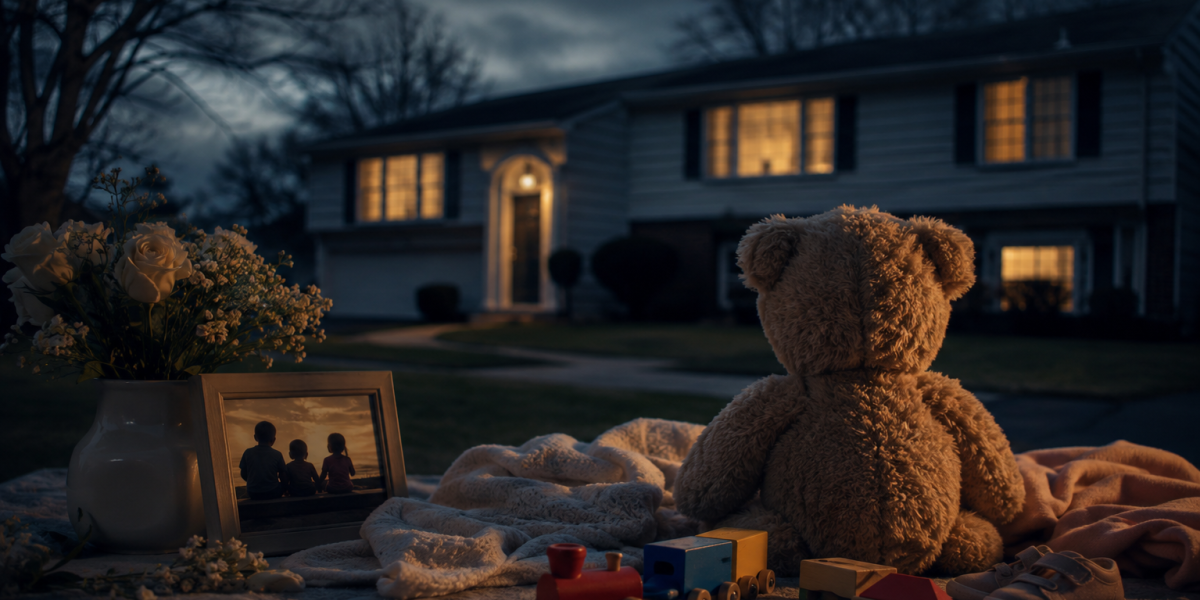
On January 24, 2023, what began as an ordinary evening for a young Massachusetts family ended in an unimaginable tragedy.
Lindsay Clancy was a labor and delivery nurse, wife, and mother of three young children. That night, her husband, Patrick, briefly left their Duxbury home to pick up dinner and medication. When he returned, everything had changed.
Their three children, Cora, Dawson, and Callan, would ultimately lose their lives, and Lindsay would survive after suffering serious injuries herself.
In this episode of Pushing Up Lilies, I walk you through what happened that night and the events surrounding the deaths of these three children.
As a nurse and former forensic death investigator, this case raises difficult questions for me, not only about the investigation itself, but about mental health following childbirth. Lindsay had reportedly been struggling with her mental health and receiving treatment before the deaths, bringing postpartum depression, postpartum anxiety, and postpartum psychosis into the national conversation.
What happens when a mother’s perception of reality becomes distorted?
How do investigators begin reconstructing a scene involving multiple children and a critically injured parent?
And how do we discuss a case this devastating while remembering that at the center of it are three children whose lives were lost?
This week, we’re focusing on the night everything happened: the timeline, the circumstances surrounding the deaths, and what investigators began to uncover.
Next week, we’ll continue with the Lindsay Clancy case as we turn our attention to the courtroom, the evidence and arguments being presented, and the complicated questions surrounding postpartum psychosis and criminal responsibility.
This is a heartbreaking case with no easy answers.
EPISODE TRANSCRIPT:
00:06
Welcome to Pushing Up Lilies. I’m your host, Julie Matson.
00:10
Pushing Up Lilies is a weekly true crime podcast with spine-tingling, unusual, and terrifyingly true stories from my perspective as a forensic death investigator and a sexual assault nurse examiner.
00:24
Do I have some stories for you? Are you ready? Hey, guys. Welcome to another episode of Pushing Up Lilies. I’m your host, Julie. I just want to say that I’m so grateful for all my followers.
00:43
I am just about to hit 100,000 downloads, which is amazing.
00:49
I’ve recorded over 200 episodes, and I am being asked to guest host on a lot of other true crime podcasts, which I’m so grateful for the friends and true crime family that I met at Beyond the Crime and then also at Crime Con.
01:07
And I’ve already… I think I told y’all, I’ve already actually applied as a creator for Crime Con 2027, which is in September 2027 in Orlando, and I’m excited about the possibility.
01:22
I will be exhibitor if I’m not chosen to be on Creators Row again. I don’t think there was really a lot of separation as far as who was on Creators Row and who was an exhibitor.
01:36
However, I know that there was a cost difference, so it doesn’t matter to me really. I used to be so focused on being a creator and you know what?
01:46
We’re all creators, and they only chose a certain number of people, and that’s fine. I don’t know how they decide that. They say that they’re fair about it. I just don’t know.
01:57
I don’t know who makes that decision.
01:59
I don’t even know how many creators they had versus exhibitors, but I know that many podcasters who had been in the podcasting world for years still were not chosen.
02:11
So, it really had nothing to do with your experience or your level of expertise or even how long you’d been doing it. Anyway, I applied as a creator, if nothing else, to save a little bit of money.
02:26
I can tell you that I think I will drive next time because the cost of shipping all my merch there was ridiculous, and it had to be there two weeks before the event, and then we had to pay Caesars Palace to store our stuff.
02:43
So, the underlying cost of podcasting, I think, is something that a lot of people don’t understand, and that’s why we work so hard to get sponsors.
02:52
This year, I am hosting my second annual Murder Mystery Dinner, and it’s gonna be in Krum, Texas. The date we have chosen is October 10th.
03:03
It’ll start at 5:00 PM, and we’re gonna have, like, a one-hour kinda meet and greet, have some drinks, visit, meet each other, and also talk to the actors.
03:15
And then at 6:00, it will start, and that is a three-hour show that will be put on during dinner. It’s very interactive. Super excited. There are opportunities this year to sponsor the event.
03:32
I will say that I have reached out to several different organizations to be a part of promoting them.
03:43
One of them is making the coasters where you can test for GHB and Rohypnol in your drink, and to put the Pushing Up Lilies logo on those and then hand them out at local bars for free.
03:58
And then also, we have two major universities in Denton, giving them to students so that they can check their drink before they take a drink to make sure that it hasn’t been tainted.
04:10
I like to help with prevention, and so those things are things that I wanna do with the sponsorship and promotion money that we get from the event, as well as to help kinda cover the costs of the podcast.
04:24
So anyway, there’s a lot of stuff up and coming, and so I’m super excited to share it with y’all.
04:28
I really don’t wanna mention the names of the organizations until I have something set in stone, but it’s gonna be exciting. There’s gonna be a lot.
04:37
I have, uh, a guest speaker lined up that y’all are going to love to hear. Her daughter was murdered, and I’m excited for her to talk to y’all. So, get ready for the tickets to go on sale.
04:48
They’ll be on Eventbrite like they were last year. Limited number, though. This venue only holds 88, so I’ve got to take into account me and then my family and the actors.
05:02
And so, when you do the math, you know, you can see that there’s not gonna be a lot of tickets.
05:10
The VIPs will be sponsors, and so they will get tickets at the front of the room and will be recognized in other ways.
05:18
So, if you own a business, and it doesn’t even have to be local, a business anywhere, we would really appreciate your collaboration in this event.
05:29
This week, I wanna talk a little bit about the Lindsey Clancy case. I know that a lot of people are familiar with it, and it’s just such a sad case.
05:39
It reminded me a lot of the Andrea Yates case, and I think I told y’all that when I was in Houston, my training, my very first training that I went to included the crime scene photos from Andrea Yates.
05:51
I mean, it was really devastating. It’s not unlike what I saw during my entire career. I saw that happen many times, but that time was the first time. It’s always so devastating, and it’s sad.
06:07
Just walking into a scene like that is hard for a death investigator.
06:13
I just always want to reach out and give a shout-out to, you know, the police officers and the death investigators and even the dispatchers who have to take these calls.
06:25
Their job is so important and so difficult. It takes a special person. Let’s talk a little bit about this case.
06:34
Now, I do wanna say that when I saw day one of the court proceedings, I love this judge. I love that he carefully explained the jury’s job to the jurors, which is important. It’s not always done.
06:51
And I do love that he said that he does not have an opinion, and that’s how I always was in sexual assault cases and in death cases. You have to go into it being unbiased, completely unbiased.
07:04
You can’t have an opinion because others are watching you, and your opinion matters to them, and your opinion is actually going to possibly affect their thoughts.
07:17
Anyway, let’s talk a little bit about who Lindsay Clancy was and the victims and what happened on the night of January 23rd, twenty twenty-three.
07:27
Lindsay was Lindsay Marie Musgrove, born August 11th of nineteen ninety, and she was raised in Wallingford, Connecticut.
07:36
She completed a rigorous accelerated nursing program that was connected to Massachusetts General Hospital, and she worked for about nine years as a labor and delivery nurse there.
07:48
Now, colleagues and family described her as very competent, caring, and very dedicated to her patients.
07:56
And in December of twenty sixteen, she married Patrick Clancy, and they actually settled in Duxbury, Massachusetts, and built what both later described as a loving family life.
08:09
Their first child was Cora. Cora was born in December of twenty seventeen, and then Dawson arrived in September of twenty nineteen, and then Callan was born on May twenty-sixth of twenty twenty-two.
08:23
Cora was five years old at the time of her death. Her father later told the court and the public that she had an infectious laugh and was just stunningly beautiful.
08:33
She was the cautious one among the three siblings, and not from fear, but because she was so deeply caring.
08:41
Now, she often said that she wanted to grow up to be a doctor and a mama, and she practiced by giving her baby brother Callan checkups. She loved her brothers and said so in her sweet voice.
08:54
She enjoyed princesses, baby dolls, and wrapping her dolls in swaddles. Preschool teachers remembered her as a wonderful student and a sweet little girl who loved her little brother.
09:06
She sometimes told people that her name was Sophia, and that was after a television character. Family photographs shown in court depicted her with this bright smile and a large red bow in her hair.
09:20
On the morning of January twenty-fourth, twenty twenty-three, her father kissed her on the head before he left the house, and that was the last time he saw her alive.
09:29
Dawson was three, and his father described him as bold, beautiful brown eyes that beamed with friendship. He was naturally humorous.
09:38
He was generous beyond the typical toddler, always willing to share his toys. For all the love he received, he gave back even more. His best quality was pure kindness.
09:51
So, he loved trucks and tractors and the television show Paw Patrol and worker guys. He liked being outside and firefighters.
10:01
On the morning of the day he died, his father photographed him celebrating after he had fully dressed himself for the first time.
10:08
And that afternoon, he sat on the couch eating chicken nuggets when his father left to run errands. Caregivers and the family nanny later described him as full of energy, rambunctious, and funny.
10:21
Callan was eight months old, born May twenty-sixth, twenty twenty-two, and he turned eight months old the day before he died.
10:28
His father called him their easygoing child, always smiling and incredibly happy and very vibrant.
10:36
In the mornings, Callan usually woke first and would rest his head on his father’s shoulder for a few minutes as he got ready to start his day.
10:45
On the afternoon of January twenty-fourth, Patrick rocked him briefly on his knees before he left the house.
10:52
When first responders reached him, Callan still had a faint pulse, and he was actually flown to Boston Children’s Hospital, placed on life support, and died on January twenty-fourth after tests showed no brain activity.
11:06
These three children formed the center of the Clancy household. Patrick later wrote and testified that they were the essence of his life and that each day with them had felt like a new gift.
11:18
Lindsay, according to family members, a nanny named Elaine Rossi, colleagues, and preschool staff, was a doting, attentive mother who gave detailed written instructions about the children’s daily schedules, when she want ’em fed, and what their routines were.
11:34
But after Callan’s birth, the picture changed dramatically, and I know that this happens, not frequently, but occasionally.
11:43
And I will say that, you know, I just did my OBGYN rotation for NP school, and I will say that we had several moms come in and discuss depression after childbirth.
11:57
It wasn’t because they didn’t have a loving family, and it wasn’t because they didn’t love their children. It was just kind of an overwhelming feeling and something that they couldn’t overcome.
12:08
Lindsay experienced a period of heightened energy at first that resembled hypomania. She would exercise extensively. She even ran a five-mile race only weeks after she delivered.
12:23
This was followed by severe anxiety, insomnia, limited roughly to three hours of sleep a night, which we all know if you don’t sleep, you are going to be completely exhausted, and how important sleep is to your health.
12:41
Numb, just emotionally numb, she had intrusive thoughts. She had actually experienced some milder postpartum anxiety after the births of Cora and Dawson, and she managed those.
12:55
She managed those with exercise and meditation and therapy. I mean, she was a nurse. She knew the things to do to help decrease her stress level, and she did those things.
13:10
Unfortunately, after Callan, the symptoms grew far more intense, so she sought help repeatedly. She visited emergency rooms, she called crisis lines, and at points she even asked to be hospitalized.
13:26
So, in early January twenty twenty-three, she spent several days as a voluntary inpatient at McLean Hospital. You know, that’s okay.
13:36
I mean, it’s okay not to be okay, and that’s something that, you know, we talk about all the time, but not everybody can hold it together all the time. So, getting help is good. It’s a good thing.
13:52
I think the stronger people are the ones who do get help, honestly.
13:57
But between September twenty-second and January twenty-third, she received prescriptions, and these involved at least thirteen different psychiatric medications, and these were all from different providers.
14:10
That list included some antidepressants like sertraline, which is Zoloft, other agents, antipsychotics like Seroquel, and all of these just at various times.
14:23
Dosages and combinations changed frequently. She reported that some of the medications made her feel worse, and sometimes the antipsychotics do.
14:33
Sometimes they make you feel worse in the beginning, and unfortunately, most of them take a couple weeks to actually kick in, and it’s hard to wait.
14:42
I mean, we all know just from regular medical symptoms that aren’t psychiatric that that waiting period for those medications to kick in is terrible, and especially when it’s a psychiatric issue and it’s affecting your daily life.
14:59
So clinical records from different encounters documented depression, anxiety, and suicidal thoughts, but she didn’t ever say that she had a specific plan.
15:11
Some providers who saw her did not diagnose psychosis at that time. Postpartum psychosis is rare, but it is recognized it’s real.
15:21
It’s a psychiatric emergency, and this occurs in about one to two of every thousand births, and it presents with very rapid onset of delusions and hallucinations, sometimes command hallucinations.
15:37
And command hallucinations are hallucinations that instruct the person to act, that instruct them to do something.
15:47
Not always a good thing but marked mood swings and just complete loss of contact with reality. And so, it’s frequently linked to an underlying bipolar vulnerability.
16:00
But if untreated, it definitely carries elevated risk of suicide, and in a minority of cases, people kill their children.
16:10
It’s considered highly treatable, but it has to be recognized promptly, and it usually does require hospitalization, and you have to carefully choose the medications, and you have to monitor those people very closely.
16:27
Ironically, Lindsay and Patrick had later filed separate civil malpractice actions alleging that providers failed to diagnose bipolar disorder with postpartum onset or postpartum psychosis, and that changing the medication regimen actually worsened her condition.
16:48
On the afternoon of January twenty-fourth, twenty twenty-three, Lindsay actually took Cora to a pediatric appointment for her five-year checkup, and she interacted normally with the receptionist, the nursing staff, and the doctor.
17:07
Later that day, she asked Patrick to pick up takeout from a restaurant and to stop at a pharmacy for the children’s medication. Didn’t seem too abnormal the day. It seemed to be going fairly well.
17:21
She took her to the doctor. No indication of what was gonna happen.
17:27
Now, the errands took Patrick roughly about forty-five minutes, and prosecutors would later argue that the request deliberately created that window of opportunity because, you know, she wouldn’t have been able to do this if Patrick had been home.
17:43
While Patrick was gone, Lindsay took the three children to the basement of the house on Summer Street, and she used exercise resistance bands as ligatures around their neck.
17:57
Cora was found face down, Dawson was found in his father’s basement office, and Callan was nearby. The medical examiner determined that the cause of death for all three was ligature strangulation.
18:12
Cora and Dawson were pronounced dead that evening at a local hospital, and Callan remained on life support until January twenty-seventh.
18:20
Now, after this, Lindsay cut her wrists and neck and jumped from a second-story window.
18:28
Patrick came home, found the house quiet, went upstairs, and he found blood in the locked bedroom and an open window, and then he found Lindsay injured on the ground outside. He called nine one one.
18:41
On the call, he asked where the children were, and Lindsay directed him to the basement, and he found them there with the bands still around their necks.
18:54
He attempted to remove the bands and to perform CPR. First responders heard him scream that she had killed the children. Officers actually saw, you know, dried blood and their lips were blue.
19:10
Lindsay was transported to the hospital. She had severe spinal injuries, and these left her permanently paralyzed from the waist down.
19:18
And so, while she was still intubated, she communicated by writing on a whiteboard, and she asked whether she needed an attorney.
19:26
From my perspective as a forensic nurse, the physical evidence obviously forms a very clear sequence. Soft ligatures are gonna produce patterned marks on the neck.
19:39
We know that these were sequential acts, you know, because of the positioning of the body and the brief unsupervised period created by the errands definitely establishes opportunity, and the sharp force injuries to her neck and wrists combined with the fall from height are consistent with a suicide attempt.
20:02
This is a feature often seen when people experience command hallucinations, and it sounds just so weird.
20:11
You know, I can’t imagine, like, hearing a voice to tell me to carry out something like that and not realizing that it’s not real.
20:22
And those of us who haven’t experienced it can’t and thank God because I don’t want to know what it’s like. Scene investigation is gonna examine whether or not there are any indicators of planning.
20:35
And so that would be a history on the computer, search history, any notes in the house.
20:44
Court documents actually referenced there were some electronic searches to methods of harm, and the defense situates those searches within the psychotic process rather than saying that she was planning, she was using them to plan, or that it was any form of rational premeditation.
21:09
Her defense attorneys are saying, “Yeah, she did this because she was not in her right mind. She did not know what she was doing.
21:16
She wasn’t purposefully trying to plan these murders.” Patrick Clancy actually released a public statement within days of the deaths, and he described the pain as excruciating and relentless, as you can only imagine losing your children.
21:32
He said he was completely lost without Cora, Dawson, and Callan, and he asked the public, though, to forgive Lindsay as he had, and he said that she, the real her, was generously loving and caring towards everyone, including him, the children, family, friends, and her patients, and that the very fibers of her soul were actually loving.
21:58
He wished only that she could find peace, and he later remarried a reproductive endocrinologist, and he moved to New York.
22:08
Once the trial began, I’ll say there was a lot of public speculation that was circulated online, and when the details of his remarriage became known, a lot of people claimed that he was having an affair with the woman that he later married and that he somehow planned or participated in the killings and that he framed Lindsay and pushed her out the window, or that small details like changing his shoes or a jacket between the pharmacy and the restaurant, you know, indicated some form of suspicious activity.
22:43
A lot of people have suggested that he left the house intending never to return or that he somehow benefited from this tragedy.
22:51
And these theories have and will appear repeatedly in social media posts. They’re gonna be in the comment sections. They’re gonna be in a lot of true crime discussion spaces.
23:04
But there is no official investigation, charging document, court filing, or piece of trial evidence that has supported any claim that Patrick Clancy was involved in the deaths of the children or that he assisted in any cover-up or that he caused Lindsay’s injuries.
23:22
Surveillance video, phone records, the nine one one call, first responder accounts, and the physical evidence actually place him outside the home during the critical window and show him actually discovering the scene and reacting with distress.
23:40
The theory remains completely unsubstantiated public speculation that runs counter to the record. So, these children were not abstractions, though. We need to remember that.
23:55
Cora practiced being a doctor on her baby brother, and Dawson shared his toys and celebrated dressing himself. Callan rested his head on his father’s shoulder in the mornings.
24:08
So, their brief lives and the manner of their deaths form the factual core of everything that followed So accurate coverage must hold both the medical history of the mother and the concrete reality of the three young victims without collapsing one into the other.
24:31
And so that’s very important in cases like this. This is gonna be a two-part series. The second part is going to kinda help describe a little bit about what happened during the court proceedings.
24:47
And from what I can tell, and I don’t know if y’all watched it, but it’s on Court TV. I’ve tried to watch most of them and will finish watching, but I’ve always loved Court TV.
25:00
I remember, you know, years ago I watched the OJ Simpson trial. I watched the Phil Spector trial.
25:09
So interesting, and one thing that I love to do is always to watch them during the testimony, watch the person on trial, and just see what kind of reactions they had.
25:21
I don’t know if y’all remember back during the Phil Spector trials, he was weird. Like, his hair was always different. He was always dressed a little bit crazy. He was a strange bird.
25:33
I loved watching it just to see how he was dressed every day, what his hair looked like. He was always not put together, like not put together at all.
25:43
I thought it strange that any girl would go to his house and be romantic with him. I don’t know. Look, I just can’t. I can’t. But I loved watching the OJ Simpson trial.
25:54
Again, I just like seeing their reaction. I like being able to see their faces. Let’s finish covering this next week. I am super excited about the Murder Mystery.
26:07
I can say that my speaker is gonna be somebody that you’re gonna love to hear. I wanna grow this and make it bigger and better every year.
26:18
I really want to use my platform as an outreach for prevention, and I hope that y’all will join me. I’ll talk to y’all next week. Stay safe and take care of yourselves. Bye y’all.
26:34
Thank you so much for joining me today on Pushing Up Lilies. If you like this podcast and would like to share with others, please do me a quick favor and leave a review on Apple Podcast.
26:45
This helps to make the podcast more visible to the public. Thanks again for spending your time with me and be sure to visit me at pushinguplilies.com for merchandise and past episodes.